Baldur's Gate 3 Villains Guide: Every Antagonist Explained
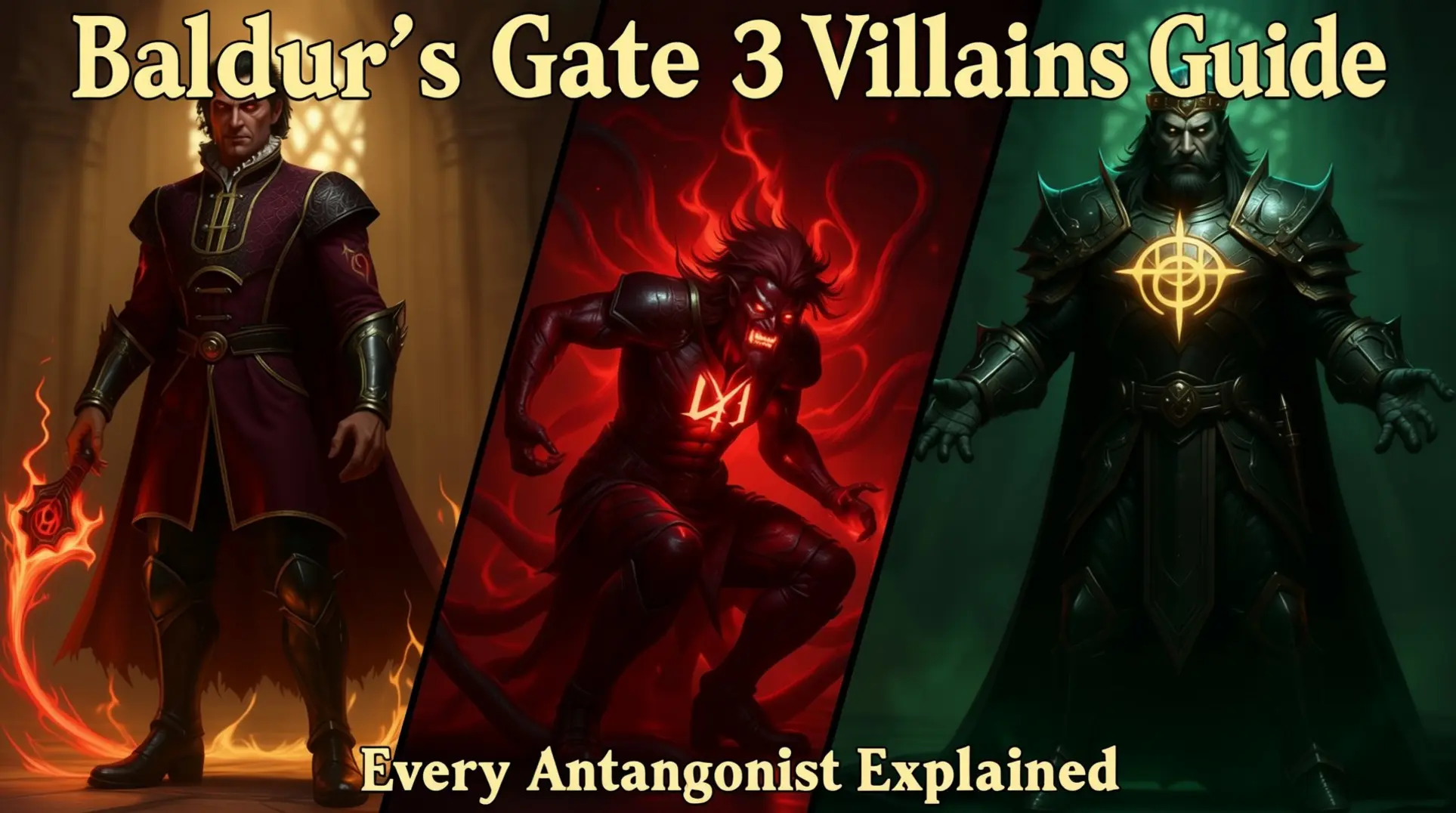
Baldur's Gate 3 features some of gaming's most complex and morally ambiguous villains. From the tragic Chosen Three to manipulative devils and corrupted heroes, each antagonist offers rich storytelling and challenging encounters. This comprehensive guide explores every major villain's backstory, motivations, and strategic approaches to defeating them.
The Chosen Three: BG3's Main Villain Trio
At the heart of Baldur's Gate 3's conflict stands a formidable alliance known as the Chosen Three. These mortal agents serve the Dead Three gods (Myrkul, Bhaal, and Bane) in a coordinated plot to regain divine power across the Sword Coast Reddit - The Dead Three's Plan.
Each villain brings unique strengths to their unholy alliance.
Ketheric Thorm, the Chosen of Myrkul
Ketheric Thorm commands the Absolute's army using Illithid tadpoles. He serves as the military backbone of their operation Villains Wiki - Ketheric Thorm.
Orin the Red, Bhaal's Chosen
Orin the Red, Bhaal's bloodthirsty chosen, creates mass murder sprees within Baldur's Gate. This generates chaos that fuels her god's portfolio of death and slaughter Orin the Red - BG3 Wiki.
Her tragic backstory reveals how her artistic talents were twisted toward murder. This was the result of a childhood trauma involving her mother Reddit - I feel sorry for Orin.
Enver Gortash, Bane's Chosen
Enver Gortash, Bane's ambitious Chosen, orchestrates a mock invasion. This positions him as the city's savior Enver Gortash - BG3 Wiki.
His journey from enslaved child to political mastermind was shaped by extreme abuse. He suffered this abuse while serving the devil Raphael, driving his ruthless pursuit of power TheGamer - Enver Gortash Origins.
Despite their coordinated efforts, each Chosen secretly plans to betray the others. This makes their alliance as fragile as it is dangerous.
Secondary Antagonists: Complex Adversaries
The Emperor: Balduran's Tragic Transformation
Few secondary antagonists in modern RPGs achieve the complexity of the Emperor. His shocking identity as Balduran—the legendary founder of Baldur's Gate—unfolds through Wyll's questline and the discovery of Ansur's remains.
Originally a human explorer, Balduran was captured by mind flayers. He was transformed through ceremorphosis, as detailed in this Reddit Community Analysis.
The Emperor's Duality
The Emperor's tragic bond with the bronze dragon Ansur underscores his duality. Ansur sought to cure him, only to be killed when the Emperor's acceptance of his new form led to a violent confrontation. This emotional core is explored further in the Baldur's Gate 3 Wiki.
Yet, the Emperor's benevolent facade is a calculated deception. His psychic domination of Duke Stelmane—presented as a partnership but revealed as manipulation through medical notes—exposes his true nature, as Screen Rant explains.
Moral Ambiguity
What makes the Emperor compelling is his moral ambiguity. He retains fragments of Balduran's identity but embodies illithid psychology, prioritizing power over liberty. This exploration of identity loss, discussed in this Reddit Deep Analysis, cements him as one of gaming's most intricate antagonists.
Auntie Ethel: The Hag's Deceptive Bargains
Among the most morally complex encounters in Act 1 is Auntie Ethel, a powerful night hag who preys on desperation and hope. Her true form—a grotesque hag with stringy gray hair and rotting teeth—stands in stark contrast to her initial appearance as a helpful herbalist Auntie Ethel - BG3 Wiki.
The Hag's Transformations
Ethel's most terrifying ability is her shape-shifting prowess. She can appear as any number of desperate, sympathetic figures to lure victims into her web. Most commonly, she takes the form of a dying woman seeking help for her sick child, exploiting the player's desire to help others.
Her true form reveals the hag's nature: a creature of corruption who feeds on suffering and despair. The transformation sequence, where her beautiful facade melts away to reveal her monstrous true self, serves as one of BG3's most memorable horror moments.
Moral Choices and Consequences
What makes Auntie Ethel particularly compelling is the moral complexity of her encounters. Players can choose to:
- Help the false child and risk becoming trapped in her illusion
- See through the deception and confront her directly
- Make a bargain that may save one person while dooming others
The most difficult choice involves Mayrina, a grieving woman desperate to save her husband. Players can warn Mayrina about Ethel's true nature, but this may doom her husband to death. Alternatively, they can allow Mayrina to make her own choice, even if it leads to tragedy.
Ethel's story explores themes of hope versus reality, the cost of desperate measures, and whether good intentions can justify potentially harmful actions. Her presence in the game serves as a reminder that not all who appear helpful have benevolent motives.
Memorable Mini-Bosses & Hidden Threats
Balthazar: Commander of the Reborn Dead
Among the Shadow-cursed Lands' many dangers, Balthazar stands out. As the Commander of the Reborn Dead, this Level 8 necromancy wizard serves as General Ketheric Thorm's key lieutenant. He presents a significant challenge for players exploring Act 2.
Unlike many within the Absolute's hierarchy, Balthazar is not a True Soul. He operates with full autonomy, his motivations rooted in a deep devotion to Myrkul, the god of death. This is evidenced by the deity's symbol on his golden chain.
His partnership with Ketheric predates the Cult of the Absolute. This makes him instrumental in the general's resurrection and the dark ritual that subdued the Nightsong. The ritual linked her immortality to Ketheric's invulnerability.
The Balthazar Encounter
Players encounter Balthazar primarily within Moonrise Towers and the Gauntlet of Shar. Here, he commands undead forces and conducts necromantic research.
His boss fight is notoriously difficult, demanding preparation due to his formidable stats (91 HP, 20 INT) and undead resistances. These grant him immunity to poison and resistance to physical damage.
Adding to the challenge is his secret chamber. It features a deadly bookcase puzzle that can reanimate corpses or unleash spikes.
His lich-like nature, hinted at in dialogue suggesting "death won't stop him from coming back," cements his status as a pivotal and complex character in the game's second act.
Villain Motivations: Understanding Evil in BG3
Baldur's Gate 3 excels at crafting morally ambiguous antagonists. The game explores how evil often arises not from inherent wickedness, but from trauma, manipulation, or impossible circumstances.
Yurgir: The Trapped Orthon
Few exemplify this better than Yurgir, the trapped Orthon encountered in Shar's Gauntlet. Unlike many villains driven by pure malice, Yurgir's motivations stem from desperation and a cruel cosmic loophole. As a powerful fiend from the Nine Hells, he struck a Faustian bargain with the cambion devil Raphael. He was tasked with exterminating all of Shar's Dark Justiciars in exchange for freedom Yurgir - BG3 Wiki.
The Impossible Contract
However, Raphael's contract was deliberately designed to be unachievable. The last Justiciar, Lyrthindor, transformed into a colony of rats using Raphael's own magic. This left Yurgir permanently trapped with impossible terms Break Yurgir's Contract - BG3 Wiki.
This predicament transforms Yurgir from a straightforward villain into a tragic figure. He is bound by infernal legalese. His primary motivation isn't destruction, but liberation from his eternal imprisonment The Gamer - Yurgir Boss Guide.
Players can exploit this desperation through persuasion. Peaceful resolutions range from convincing him to sacrifice his minions to taking his own life VG247 - Decision Guide.
Raphael: The Devil's Gambit
Perhaps no antagonist embodies manipulative evil more perfectly than Raphael, the cambion devil who serves as one of BG3's most formidable and morally complex villains. Operating from his nightmarish palace in the Nine Hells, Raphael represents the classic devil archetype: a being who offers exactly what people want, but always at a price that ultimately serves his own interests Raphael - BG3 Wiki.
Contract Manipulation and Devil's Bargains
Raphael's primary motivation centers on acquiring the Crown of Karsus, an artifact of immense power that could elevate him from cambion to true devil nobility. His strategy involves manipulating desperate individuals into making deals they cannot possibly fulfill, trapping them in eternal servitude.
His most notable victim is Enver Gortash, whose childhood enslavement and abuse at Raphael's hands shaped the future Chosen of Bane into a ruthless political mastermind. This backstory, detailed in TheGamer's analysis, demonstrates Raphael's long-term thinking and willingness to invest decades in cultivating future assets.
The House of Hope Heist
Raphael's palace, the House of Hope, serves as both his power base and a testament to his manipulative nature. The building itself is a psychological trap, designed to break visitors' spirits through impossible architecture and psychological torment. His relationship with his enslaved wife, Hope, whom he keeps as a living battery to power his palace, exemplifies his capacity for cruelty masked as necessity.
What makes Raphael particularly insidious is his genuine offers of help. He provides legitimate solutions to the player's illithid parasite problem, but always with strings attached that could damn the character's soul. This moral ambiguity forces players to question whether accepting his help, despite the risks, might be the lesser evil compared to ceremorphosis.
His story illustrates how Baldur's Gate 3's "evil" often arises not from inherent wickedness, but from exploitative systems. Manipulative antagonists like Raphael force both characters and players to question the nature of villainy itself.
Strategic Approaches to Each Villain Encounter
The Ansur Encounter: Multi-Phase Dragon Combat
The Ansur encounter in Baldur's Gate 3 demands a multi-phase tactical approach. It blends preparation with adaptability. Before engaging this formidable bronze dragon, players must first navigate the Wyrmway's four puzzle chambers. Each tests different aspects of character judgment and skill.
These trials serve as both narrative铺垫 and practical preparation for the confrontation ahead.
Positioning and Defense
Once the battle begins, positioning becomes paramount. Spread your party members to avoid Ansur's devastating multi-target attacks. This is especially important for the Tail Whip, which can knock multiple characters prone.
The most critical threat is Stormheart Nova. This is a massive lightning attack that triggers when Ansur reaches 50-66% health or automatically on turn four. The ability can deal approximately 100 lightning damage across the entire arena, making defensive preparation essential.
To counter the nova, Globe of Invulnerability offers complete protection. Lightning resistance potions provide an alternative safeguard.
Offensive Strategy
Offensive strategy should focus exclusively on Ansur rather than his Myrmidon supporters. Interestingly, the nova attack will damage all enemies simultaneously. This turns the dragon's most powerful ability against his own allies.
This layered approach transforms what initially seems like an overwhelming encounter. It becomes a manageable tactical challenge that rewards careful planning over brute force.
Auntie Ethel: Illusion and Truth Combat
The Auntie Ethel encounter presents unique challenges due to her illusion magic and shape-shifting abilities. Success requires recognizing deception and making difficult moral choices.
Phase 1: The Deception
Initially, players encounter "Auntie Ethel" as a concerned herbalist seeking help for her sick niece. This interaction tests the player's ability to read social cues and recognize inconsistencies in the NPC's story. Key indicators of deception include:
- Vague details about the child's condition
- Reluctance to provide specific location information
- Urgency that seems disproportionate to the situation
Phase 2: The Transformation
When confronted with the truth, Ethel reveals her true hag form. This transformation sequence is both narrative and mechanical, as her abilities change dramatically. Her true form grants her:
- Enhanced illusion capabilities
- Powerful curse abilities
- Regeneration and resistance to certain damage types
Tactical Considerations
- Truth Detection: Spells like Detect Thoughts or Zone of Truth can help identify deception early
- Moral Preparation: Decide beforehand whether to prioritize saving Mayrina or exposing Ethel's deception
- Area Control: Ethel's illusions can confuse party positioning, making crowd control spells valuable
Raphael: The Devil's Palace
The encounter with Raphael in his House of Hope represents one of BG3's most challenging strategic puzzles, combining combat, stealth, and social encounters.
Preparation Phase
Before entering Raphael's domain, players should:
- Gather Information: Learn about the palace's impossible architecture and psychological traps
- Prepare for Multiple Encounters: Expect both combat and dialogue-heavy sections
- Stock Up: Ensure adequate healing supplies and spell slots for the multi-phase encounter
The House of Hope Structure
The palace itself is a puzzle, with rooms that shift based on the visitor's fears and desires. Key areas include:
- The Entry Hall: Tests resolve and determination
- Hope's Chamber: Requires careful social interaction to avoid triggering traps
- Raphael's Throne Room: The final confrontation location
Combat Strategy
Raphael himself is a formidable opponent with:
- High-level spellcasting abilities
- Legendary actions and resistances
- The ability to summon additional enemies
Key tactical considerations include:
- Spell Disruption: Counterspell and Dispel Magic are essential
- Area Denial: Prevent him from using his full spell repertoire
- Focus Fire: Prioritize eliminating his summoned allies before engaging him directly
Alternative Approaches
Players can potentially avoid direct combat through:
- Negotiation: Using high Charisma checks and previous relationship building
- Stealth: Avoiding detection through the palace's security systems
- Puzzle Solving: Using environmental hazards to damage or weaken Raphael
Balthazar: Necromantic Mastery
The Balthazar encounter combines environmental hazards with challenging combat mechanics.
Pre-Fight Preparation
- Undead Resistance: Prepare weapons and spells that bypass undead resistances
- Poison Immunity: Balthazar is immune to poison damage
- Area Control: Expect multiple undead allies and environmental hazards
Combat Mechanics
Balthazar's key abilities include:
- Necromantic Spells: High-level spells for controlling undead
- Undead Resilience: Resistance to physical damage, immunity to poison
- Environmental Manipulation: Ability to use the room's hazards against players
Strategic Approach
- Priority Targeting: Focus on Balthazar before his undead allies
- Environmental Awareness: Use or avoid the room's hazards strategically
- Spell Management: Save powerful spells for when Balthazar's defenses are down
Conclusion: Why BG3's Villains Elevate the Story
Baldur's Gate 3's villains transcend traditional good-versus-evil narratives. They explore how ordinary individuals become antagonists through trauma, manipulation, or impossible choices.
From Ketheric's grief-driven descent to Yurgir's contractual imprisonment, each villain serves as a cautionary tale. They highlight the price of power and the complexity of moral choices.
The inclusion of complex figures like Raphael—with his centuries-long manipulation of souls—and Auntie Ethel—with her exploitation of hope and desperation—demonstrates the game's commitment to morally gray storytelling. These aren't simple monsters to be slain, but characters whose motivations, while evil, are understandable and even relatable in their own twisted way.
This nuanced approach to antagonist design elevates BG3 beyond typical fantasy RPGs. It creates memorable encounters that challenge players to understand rather than simply defeat their adversaries. Each villain serves as a mirror, reflecting the consequences of choices made in desperation, the corrupting influence of power, and the thin line between heroism and villainy.
The game's greatest achievement lies not in providing easy answers about good and evil, but in presenting situations where the "right" choice is unclear, and where victory often comes at a moral cost. This complexity ensures that Baldur's Gate 3's villains will be remembered long after the game is finished, not as obstacles to overcome, but as characters who shaped the player's journey through their own complex humanity.
More Baldurs-Gate-3 Guides
Baldur's Gate 3 Act 1: The Complete Guide to Quests, Companions, and Loot
Master Baldur's Gate 3 Act 1 with our exhaustive guide. Covering essential quests, companion arcs, hidden treasures, and optimal progression to avoid missed content.
Baldur's Gate 3 Evil Playthrough: Ultimate Guide to Endings & Strategy
Master Baldur's Gate 3's evil playthrough with our comprehensive guide covering endings, quest order, party composition, and difficulty strategies.

Ultimate BG3 Character Creation Guide: Build Your Perfect Hero
Master Baldur's Gate 3 character creation with our comprehensive guide covering race-class synergies, visual customization, essential tools, and beginner mistakes to avoid.
AI Tactical Companion
Consult with our specialized tactical engine for Baldurs-Gate-3 to master the meta instantly.