EU4 Beginner's Guide: 5 Best Starting Nations (2025) - Ottomans, Portugal & More
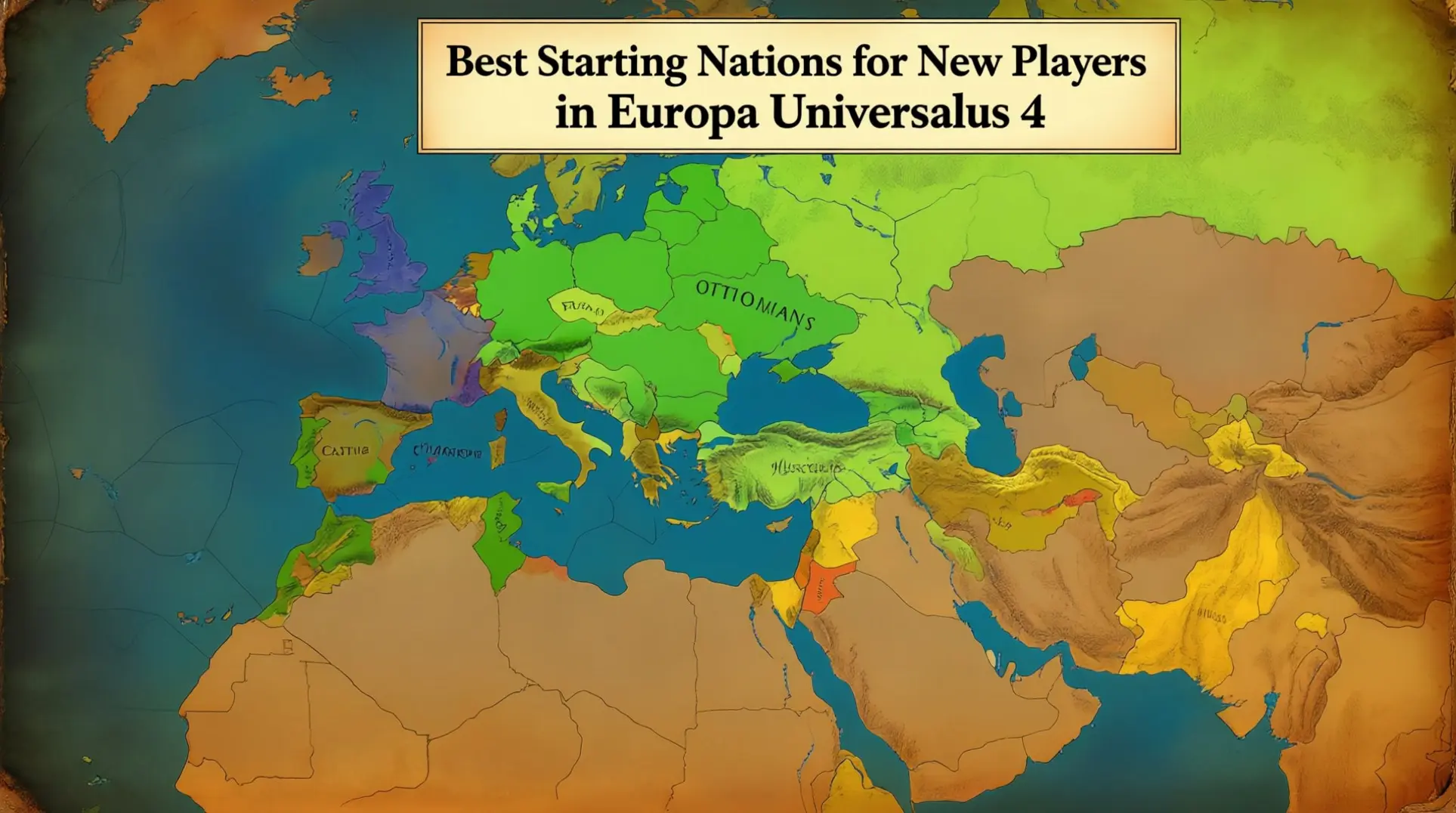
Europa Universalis 4 presents a daunting learning curve for new players, but choosing the right starting nation can transform this complexity into an enjoyable learning experience. The Ottoman Empire stands as the undisputed champion for complete beginners, offering military dominance and forgiving expansion mechanics that allow players to learn core mechanics without constant threat of collapse. Portugal provides a peaceful alternative focused on colonization and trade, while Castile offers balanced gameplay with both European and colonial ambitions. France teaches warfare and diplomacy through its powerful army and vassal management, and Muscovy introduces players to massive territorial expansion and empire building. Each of these five nations provides unique pathways to mastering EU4's complex systems while minimizing the frustration that often accompanies early learning experiences.
Why Starting Nation Choice Matters for Beginners
Starting nation choice is crucial for beginners because EU4 has a steep learning curve with complex mechanics including diplomacy, warfare, economy, and technology that can overwhelm new players. Beginner-friendly nations like Ottomans provide safety nets through strong military, forgiving expansion mechanics, and economic stability that allow new players to learn without immediate threat of destruction.
Choosing nations with natural geographic advantages reduces the number of hostile borders and aggressive expansion concerns for beginners. Nations with strong starting positions and military power allow beginners to survive early mistakes in warfare and diplomacy that would be fatal for smaller, weaker nations. Recommended beginner nations are specifically chosen because they teach core game mechanics in manageable chunks - Ottomans for warfare, Portugal for colonization, France for diplomacy, etc.
Starting with powerful nations gives beginners room to experiment with different playstyles and learn mechanics without the constant pressure of imminent collapse from AI aggression. The choice of starting nation directly impacts survival chances as weaker nations face immediate threats from larger neighbors and coalitions that require advanced diplomatic skills to manage. Beginner-friendly nations typically have strong economies that can absorb financial mistakes and support larger armies, providing a buffer while learning trade, taxation, and production mechanics. Starting with recommended nations helps avoid the frustration of early game overextension, coalition wars, and bankruptcy that often causes new players to quit the game entirely. The learning curve is significantly flattened when playing nations with clear historical paths and strong national ideas that guide players toward successful strategies.
The Ottomans: Ultimate Beginner Powerhouse
Key Strengths & Starting Position
The Ottoman Empire begins Europa Universalis 4 on November 11, 1444, owning most of Anatolia and the southern Balkans, making them the strongest starting nation in the game. Ottomans start with a substantial force limit allowing them to field a large army from day one, far surpassing most immediate neighbors due to their extensive territorial holdings.
Anatolian technology group: The tech group providing Ottoman units overwhelming destructive power compared to standard Western units, maintaining military advantage until technology level 15. Janissaries: Elite infantry units that Ottomans can recruit at no monetary or manpower cost, providing significant qualitative edge over adversaries.
Ottoman's strategic position straddles the crossroads of Europe and Asia, offering unparalleled expansion opportunities across multiple fronts but requiring careful logistics management. Capturing Constantinople is a primary early objective as it unlocks the empire's full potential with its high development and strategic strait control. Ottoman's geographical position naturally mitigates aggressive expansion concerns, as conquests can be spread across different cultural and religious groups in three regions.
- Janissaries can be recruited instantly and are particularly effective at assaulting forts.
- This allows for efficient sieging squads with careful micromanagement.
- Ottoman's starting position allows them to fight one war at a time while managing multiple neighbors through careful diplomacy and truce timing.
Early Game Strategy
Before declaring war on Byzantium, set army maintenance to zero to save money. Build troops to force limit and set rivals to potentially secure beneficial diplomatic situations. Ottomans' first war should be against Byzantium to capture Constantinople, a province that is economically and strategically vital as a Center of Trade and removes Byzantine cores on Ottoman Balkan provinces.
Use Ottoman naval superiority to blockade the Strait of Bosporus, preventing the Byzantine army in Morea from reinforcing Constantinople during the siege. After capturing Constantinople, fully annex the Byzantine Empire to secure the province and remove the persistent threat to Ottoman Balkan holdings.
Following the Byzantine conquest, focus on unifying Anatolia by conquering Turkish Beyliks like Karaman, Candar, and Dulkadir. Use permanent claims that reduce coring costs and aggressive expansion. After securing Anatolia, expand into the Balkans targeting Serbia, Bosnia, and Wallachia, managing aggressive expansion carefully to avoid triggering coalitions from Hungary or Venice.
Humanist Ideas: The first recommended idea group providing +25% Religious Unity, -2 National Unrest, and -10 Years of Separatism. This significantly reduces rebellion problems across the diverse empire.
Idea Group Recommendations
Humanist Ideas are recommended first for Ottomans to provide +25% Religious Unity, -2 National Unrest, and -10 Years of Separatism. These stack with Ottoman traditions to virtually eliminate rebellions in newly conquered heathen land. Humanist ideas also provide +30% Improve Relations which helps aggressive expansion decay faster. For beginners, Humanist first is often the safer, more forgiving choice as it automates stability management, allowing focus on warfare and diplomacy without constantly suppressing rebels.
Administrative Ideas: Provides -25% Core-Creation Cost (CCR) which saves vast amounts of administrative monarch points, allowing coring more territory faster and for less cost. They also provide +5 Maximum Promoted Cultures to help integrate large cultural groups and -10% Advisor Cost to afford better advisors for more monarch points.
Influence Ideas: Offers -25% Diplomatic Annexation Cost for integrating vassals efficiently and -50% Unjustified Demands for taking land in wars without direct claims. Influence ideas provide +1 Diplomatic Relation and +50% Vassal Income, making managing a network of vassal states more viable and profitable.
The Humanist-Administrative-Influence trio synergizes to address primary challenges of a growing empire, including internal stability, expansion costs, and diplomatic relations with conquered territories. Many experienced players recommend taking Administrative ideas first or second to maximize point savings over the campaign. After the core trio, Offensive Ideas are recommended for +20% Siege Ability and +1 Land Leader Fire, or Quantity Ideas for increased manpower pool and regeneration.
Portugal: Peaceful Colonization Master
Key Strengths & Starting Position
Portugal begins in 1444 with a secure position on the Iberian Peninsula, sharing borders only with Castile to the east and Granada to the south. This provides natural protection for colonial expansion. Portugal's national ideas provide significant bonuses to colonial growth, global trade power, and naval capabilities, making them ideal for building a maritime trade empire without excessive maintenance costs.
Securing a strong alliance with Castile immediately at game start is crucial for Portugal's security. This neutralizes the largest immediate military threat and allows Portugal to reduce army size for naval investment. The alliance enables Portugal to focus resources on navy and economy rather than maintaining a large standing army for land defense. Portugal's strategic position on the Atlantic coast provides direct access to key trade nodes and colonial routes to Africa, the Americas, and Asia.
Exploration Ideas: This is the mandatory first choice for Portugal, unlocking explorers, increasing colonial range, and providing a free colonist to begin overseas expansion immediately. Early colonization targets for Portugal include the Canary Islands, Cape Verde, and Arguin as stepping-stones to reach the Americas and African trade regions. Portugal's national ideas include bonuses to trade efficiency and global trade power, enabling them to dominate trade nodes like Sevilla and control wealth flowing from colonies.
Early Game Strategy
Portugal's first priority is securing a strong alliance with Castile immediately at game start. This ensures land border security and enables focus on naval and colonial expansion. After securing the Castile alliance, Portugal should immediately begin building a strong navy to protect trade routes and support future colonial expeditions.
Portugal should take Exploration Ideas as their first idea group to unlock explorers, increase colonial range, and gain a free colonist for early overseas expansion. Early colonization targets include strategic stepping-stones:
- Canary Islands (if not taken by Castile)
- Cape Verde
- Arguin
Portugal should prioritize reaching the Caribbean and Brazil first in the New World, as these regions provide valuable trade goods and colonial nations. Portugal can optionally attack Morocco early to secure Tangiers and Ceuta for additional trade power, also denying Castile these strategic positions.
Focus on developing the economy through trade and light ships protecting the Sevilla trade node, which becomes increasingly valuable as colonies develop. Maintain good relations with England and France as secondary allies to counterbalance potential Castilian aggression if the alliance breaks down. Use the alliance with Castile to participate in their wars against Granada, potentially gaining territory or favors without bearing the brunt of the fighting. Portugal's strategy should focus on building a global trade empire rather than European territorial expansion, leveraging their naval and colonial advantages.
Idea Group Recommendations
Exploration Ideas are mandatory first choice for Portugal, providing explorers, conquistadors, +50% Colonial Range, and a free colonist to begin overseas expansion immediately. Colonial Range: This determines how far your ships can explore and establish colonies from your nearest core province.
Expansion Ideas are recommended second for Portugal, providing an additional colonist, +20 Global Settler Increase, and reduced native uprising chance for faster colonial growth. Global Settler Increase: This increases the speed at which your colonies grow each year. Trade Ideas provide +25% Global Trade Power, +1 Merchant, and +20% Trade Efficiency, which synergize perfectly with Portugal's colonial trade empire strategy.
Economic Ideas provide +10% Tax Modifier, -0.05 Monthly Autonomy Change, and -20% Development Cost, helping Portugal develop their small homeland territory efficiently. The Exploration-Expansion-Trade trio creates a powerful synergy for Portugal's colonial and trade-focused gameplay, maximizing income from overseas territories.
For military support, consider these options:
- Quantity Ideas to overcome small manpower pool (+50% National Manpower Modifier)
- Naval Ideas to enhance naval dominance (+10% Heavy Ship Combat Ability)
- Defensive Ideas for army survival (+15% Morale of Armies)
- Quality Ideas to make limited forces more effective
For beginners, the recommended order is Exploration first, followed by Expansion or Trade, then Economic or Quantity depending on whether economic or military needs are more pressing.
Castile: Balanced Empire Builder
Key Strengths & Starting Position
Castile begins in 1444 as a major power on the Iberian Peninsula with immediate access to colonization. Their strategic position offers a unique potential for the Iberian Wedding event that creates a personal union with Aragon.
Iberian Wedding: This event can fire between 1450-1530 when Castile or Aragon has a female heir or regency, requiring both nations to have a royal marriage and not be at war. Disinheriting the weak starting heir Enrique (0/0/0 skills) increases these chances.
Castile's national ideas provide powerful bonuses across military, colonial, and administrative domains. The combination of Iberian Shipbuilding (-15% ship costs, +25% naval force limit) and Inter Caetera (+1 yearly settler increase, +25% global settler chance) enables strong colonial expansion. Siglo de Oro: Provides +1 to all monarch power points (administrative, diplomatic, military), making rulers more effective throughout the mid-game. Spanish Inquisition: Grants +2 yearly papal influence and reduced unrest from heretic/heathen provinces. Spanish Tercios: Offers +15% infantry combat ability for enhanced military effectiveness. Castile's national ambition provides +25% religious unity, helping manage diverse empires. Combined with their control of the Sevilla trade node, these strengths enable balanced gameplay between continental expansion and colonial empire building.
Early Game Strategy
Castile begins with the 'Castilian Civil War' disaster that triggers if legitimacy falls below 50. This requires immediate attention to manage stability and avoid negative events through high legitimacy, positive stability, and keeping the nobility estate loyal. Castilian Civil War: A potential disaster that must be actively prevented through careful management of legitimacy and estate loyalty.
The first military action should be conquering Granada to complete the Reconquista. This provides permanent claims on North Africa and prestige bonuses while securing the southern frontier. Reconquista: The historical campaign against Granada that yields permanent claims and prestige for Castile.
Securing alliances with Portugal and Austria early provides protection against France and helps manage aggressive expansion. After Granada, focus on North African expansion by taking provinces like Tangiers and Fez to control the Gibraltar trade node and secure Mediterranean access. Maintain good relations with Aragon to increase chances of the Iberian Wedding firing. Exploration ideas should be taken as the first or second idea group to begin colonization in the Caribbean and South America before other European powers. After the Iberian Wedding fires, integrate Aragon diplomatically to form Spain and gain access to their powerful navy and Mediterranean territories.
Idea Group Recommendations
Exploration Ideas are essential first choice for Castile, providing explorers, conquistadors, +50% Colonial Range, and a free colonist to establish early colonial empires in the Americas. This sets the foundation for Castile's overseas expansion. Religious Ideas provide +1 Missionary, +2% Missionary Strength, and Deus Vult casus belli, which is particularly valuable for Castile's Reconquista and New World conversion campaigns.
Deus Vult: A casus belli that allows religious wars, enabling easier conquest of heathen provinces. Diplomatic Ideas provide +1 Diplomatic Relation, +2 Diplomatic Reputation, and -20% Province War Score Cost, helping Castile manage multiple alliances and integrate Aragon after the Iberian Wedding.
For beginners, the recommended order is:
- Exploration first
- Religious or Diplomatic second
- Expansion or Quantity third depending on colonial or military priorities
Expansion Ideas provide an additional colonist, +20 Global Settler Increase, and reduced native uprising chance. Quantity Ideas offer +50% National Manpower Modifier and +50% Land Force Limit to compete with France. Administrative Ideas provide -25% Core-Creation Cost and +5 Maximum Promoted Cultures for managing a sprawling empire.
France: European Military Juggernaut
Key Strengths & Starting Position
France begins in 1444 as the strongest Western European power with the largest army in Europe. The nation controls high development provinces in the Paris region, providing a strong economic and manpower base for early expansion.
Elan!: This French national idea grants +20% Morale of Armies, making French troops exceptionally resilient in battle throughout the game. Additional national ideas provide +20% National Manpower Modifier and +10% Land Force Limit, allowing France to field massive armies without significant investment.
France's strategic position in Western Europe allows expansion in multiple directions—into the British Isles, Iberia, Italy, or the Holy Roman Empire. The French government type provides +1 Diplomatic Relation, enabling management of more vassals and allies simultaneously. France starts with several vassals that can be integrated over time, providing additional territory and development without aggressive expansion penalties. The French vassal swarm strategy involves using vassals to fight wars and manage conquered territory, reducing administrative burden and aggressive expansion. France begins with cores on English-held territories in mainland France, providing immediate reconquest casus belli against England. National ideas also include -10% Technology Cost, helping maintain technological parity despite frequent warfare.
Early Game Strategy
France begins with five appanage vassals that cannot be diplomatically annexed until 1454. Integrating each vassal requires land seizure from the Nobility estate for each vassal integration. Strong Duchies: This French estate privilege provides +3 diplomatic relations instead of the usual +2, allowing France to manage all five starting vassals without incurring penalties.
The first military priority should be reclaiming cores from England in the Hundred Years' War. Some strategies recommend taking only continental provinces like Caux to avoid becoming too powerful too quickly. Expanding into the Holy Roman Empire incurs a +50% aggressive expansion penalty, making careful AE management essential to avoid triggering massive coalitions against France. The Reconquest casus belli strategy involves releasing nations as vassals then using their claims to reconquer territory, generating significantly less aggressive expansion than direct conquest.
Key early game tactics include:
- Waiting for the Shadow Kingdom event and the Reformation to lower aggressive expansion penalties when expanding into HRE territory
- Truce juggling by declaring war on potential coalition members before a larger bloc forms
- Focusing on the Burgundian Inheritance event chain after securing the French heartland
- Dismantling the HRE by winning the Protestant League War to remove the +50% AE penalty
Influence Ideas: These are recommended first for France to reduce diplomatic annexation cost for vassals and reduce aggressive expansion impact when expanding into the HRE.
Idea Group Recommendations
Influence Ideas: These are recommended first for France to provide -25% Diplomatic Annexation Cost for integrating vassals and -50% Unjustified Demands for taking land in wars without direct claims. They reduce aggressive expansion impact when expanding into the HRE.
Administrative Ideas: These provide -25% Core-Creation Cost and +5 Maximum Promoted Cultures, valuable for managing France's expanding empire and reducing administrative point costs.
Quantity Ideas: These provide +50% National Manpower Modifier and +50% Land Force Limit, complementing France's already large army and manpower pool.
Offensive Ideas: These provide +20% Siege Ability, +1 Land Leader Fire, and +5% Discipline, making French armies more effective at breaking enemy fortifications.
Humanist Ideas: These provide +25% Religious Unity and -2 National Unrest, helping France manage religious diversity and reduce rebellion problems during expansion.
Diplomatic Ideas: These provide +1 Diplomatic Relation, +2 Diplomatic Reputation, and -20% Province War Score Cost, useful for managing alliances and vassal integration.
Defensive Ideas: These provide +15% Morale of Armies and -25% Land Attrition, stacking with France's Elan! national idea for exceptional army morale.
Quality Ideas: These provide +10% Infantry Combat Ability, +10% Cavalry Combat Ability, and +10% Artillery Combat Ability, enhancing French military quality across all unit types.
Economic Ideas: These provide +10% Tax Modifier and -20% Development Cost, helping France develop their high-development provinces more efficiently.
For beginners, the recommended order is Influence first for vassal management, followed by Administrative or Quantity, then Offensive or Humanist depending on expansion or military priorities.
Muscovy: Continental Empire Builder
Key Strengths & Starting Position
Muscovy begins in 1444 with several vassal states including Yaroslavl, Beloozero, Rostov, and Tver, providing a strong power base in the Russian region. Siberian Frontier: This national idea allows automatic colonization of adjacent uncolonized provinces without needing colonists, enabling rapid eastward expansion across Asia.
Muscovy's strategic position allows expansion in multiple directions: north against Novgorod, east into Siberia, south against the steppe hordes, and west into Europe. The Russian government type provides valuable bonuses for empire management, granting +1 Diplomatic Relation and +10% Manpower Recovery Speed.
Russian national ideas support massive military expansion, providing +33% National Manpower Modifier, +50% Land Force Limit, -10% Core-Creation Cost, and +1 Yearly Legitimacy. Muscovy starts with the Tatar Yoke modifier, requiring payment of tribute to the Golden Horde until you can break free through military victory.
- Integrate starting vassals to consolidate power in the Russian heartland
- Use diplomatic vassalization blitz for other Russian minors
- After forming Russia, gain access to Streltsy special units
Early Game Strategy
Your first major war should target Novgorod to secure rich provinces and control of the vital northern trade node. After defeating Novgorod, integrate your starting vassals—Yaroslavl, Beloozero, Rostov, and Tver—to consolidate the Russian heartland. Manage the Tatar Yoke carefully while expanding, paying tribute to the Golden Horde until you're strong enough to defeat them militarily.
Secure alliances with major powers like Denmark or Poland to help counterbalance threats from steppe hordes. Religious Ideas are recommended as your first idea group, providing missionaries, missionary strength, and Deus Vult casus belli against non-Orthodox neighbors.
Forming Russia requires controlling Moscow, Novgorod, and Tver, and reaching administrative technology level 10. After forming Russia, immediately begin Siberian expansion using the Siberian Frontier ability to colonize eastward toward the Pacific Ocean. Once the Russian heartland is secure, expand in two directions: push south against the hordes and west into the Commonwealth for valuable European territories.
Idea Group Recommendations
Religious Ideas should be taken first, providing +1 Missionary, +2% Missionary Strength, and Deus Vult casus belli for conversion campaigns. Influence Ideas help manage vassal integration, offering -25% Diplomatic Annexation Cost and -50% Unjustified Demands.
Administrative Ideas reduce coring costs significantly, with the -25% Core-Creation Cost saving administrative monarch points for faster expansion. Quantity Ideas complement Russia's manpower advantages, adding +50% National Manpower Modifier and +50% Land Force Limit for enormous armies.
Offensive Ideas improve military effectiveness, providing +20% Siege Ability, +1 Land Leader Fire, and +5% Discipline. Expansion Ideas support early colonization, granting an additional colonist and +20 Global Settler Increase before gaining Siberian Frontier.
Humanist Ideas help manage religious diversity, offering +25% Religious Unity and -2 National Unrest across your vast empire. Trade Ideas boost economic control, providing +25% Global Trade Power and +1 Merchant for managing trade nodes.
Defensive Ideas benefit large armies, granting +15% Morale of Armies and -25% Land Attrition for operations across vast territories.
For beginners, follow this recommended order:
- Religious first for casus belli and conversion
- Influence or Administrative for vassal/territorial management
- Quantity or Offensive depending on military needs
Beginner Nation Comparison Table
| Nation | Playstyle | Difficulty | Key Strengths | Ideal Player Type |
|---|---|---|---|---|
| Ottomans | Military Conquest & Empire Building | Very Easy | Overwhelming military power, forgiving expansion, strong economy | Complete beginners wanting to learn warfare |
| Portugal | Colonization & Trade | Very Easy | Secure Castile alliance, isolated position, naval/colonial bonuses | Players interested in trade and exploration |
| Castile | Colonization & Dominance | Easy | Iberian Wedding event, balanced gameplay, strong colonial ideas | Players wanting variety and multiple options |
| France | Military & Diplomatic Power | Easy | Largest European army, high development, vassal management | War-focused players learning diplomacy |
| Muscovy | Territorial Expansion | Medium | Forms Russia, Siberian Frontier, vassal integration | Players wanting to manage large land empires |
Essential Beginner Tips for All Nations
Interface and Game Pace
The pause button is your most important tool as a beginner - use it liberally to assess situations and issue commands without time pressure. Set game speed to slower settings (1-3) to observe cause-and-effect relationships. Hover your cursor over interface elements to reveal detailed tooltips explaining functions and current status. Use your nation's mission tree as a learning guide that provides objectives and valuable rewards.
Diplomacy and Alliances
Secure strong alliances immediately with nations that share your rivals for protection and war support. Check the 'Trust' and 'Favors' tabs in diplomacy - high trust makes allies reliable, while favors can call them into offensive wars. Use 'Improve Relations' to reach the +100 relationship threshold needed for alliances. Always check alliance networks before declaring war to avoid larger conflicts than anticipated.
Economic Management
Avoid taking loans whenever possible as interest payments drain your economy. Build churches and workshops in high-development provinces first for best returns. Lower army maintenance during peacetime to save money significantly. Focus on developing provinces with valuable trade goods like cloth or silk rather than low-value goods. Use light ships to protect trade in your home node for increased income.
Learning Through Failure
Expect to lose your first few campaigns - failure is part of the learning process in EU4's complex systems. Don't be afraid to restart campaigns as each attempt teaches new mechanics. Learn from coalition wars about aggressive expansion management. Use the 'Observe' feature to watch how the AI plays your nation after losses. Bankruptcy teaches debt management and maintaining positive income.
Conclusion
Choosing the right starting nation in Europa Universalis 4 can dramatically accelerate your learning curve while ensuring an enjoyable experience. The Ottomans remain the top recommendation for complete beginners due to their military dominance and forgiving mechanics. Portugal offers a peaceful path focused on trade and colonization, while Castile provides balanced gameplay with both European and colonial ambitions. France excels at teaching warfare and diplomacy through its powerful army, and Muscovy introduces players to massive territorial expansion. Each nation offers unique learning opportunities, but all provide the safety nets and clear objectives that new players need. Remember that failure is part of the learning process - embrace mistakes as opportunities to understand EU4's complex systems better. With these recommended nations and essential tips, you're well-equipped to begin your journey into one of history's most engaging grand strategy games.
More Europa-Universalis-V Guides
Europa Universalis V Economy Mastery: Maximizing Ducats, Development & Wealth
Complete guide to mastering EU5's economic system with strategies for tax income, production optimization, trade dominance, and long-term wealth building through population management and strategic development.
Advanced EU5 Colonization Strategy: Build Your Global Empire
Master EU5's sophisticated colonization mechanics with our comprehensive guide to building global empires through strategic range, settler management, and trade optimization.
EU5 Institutions Guide: Mastering Technology Cost & Spread Strategies
Master Europa Universalis V institutions with our complete guide to technology cost penalties, spread mechanics, and the 20% adoption threshold for optimal gameplay.
AI Tactical Companion
Consult with our specialized tactical engine for Europa-Universalis-V to master the meta instantly.