Melinoë's Metamorphosis: From Obscure Goddess to Hades II's Restoration Hero
Introduction
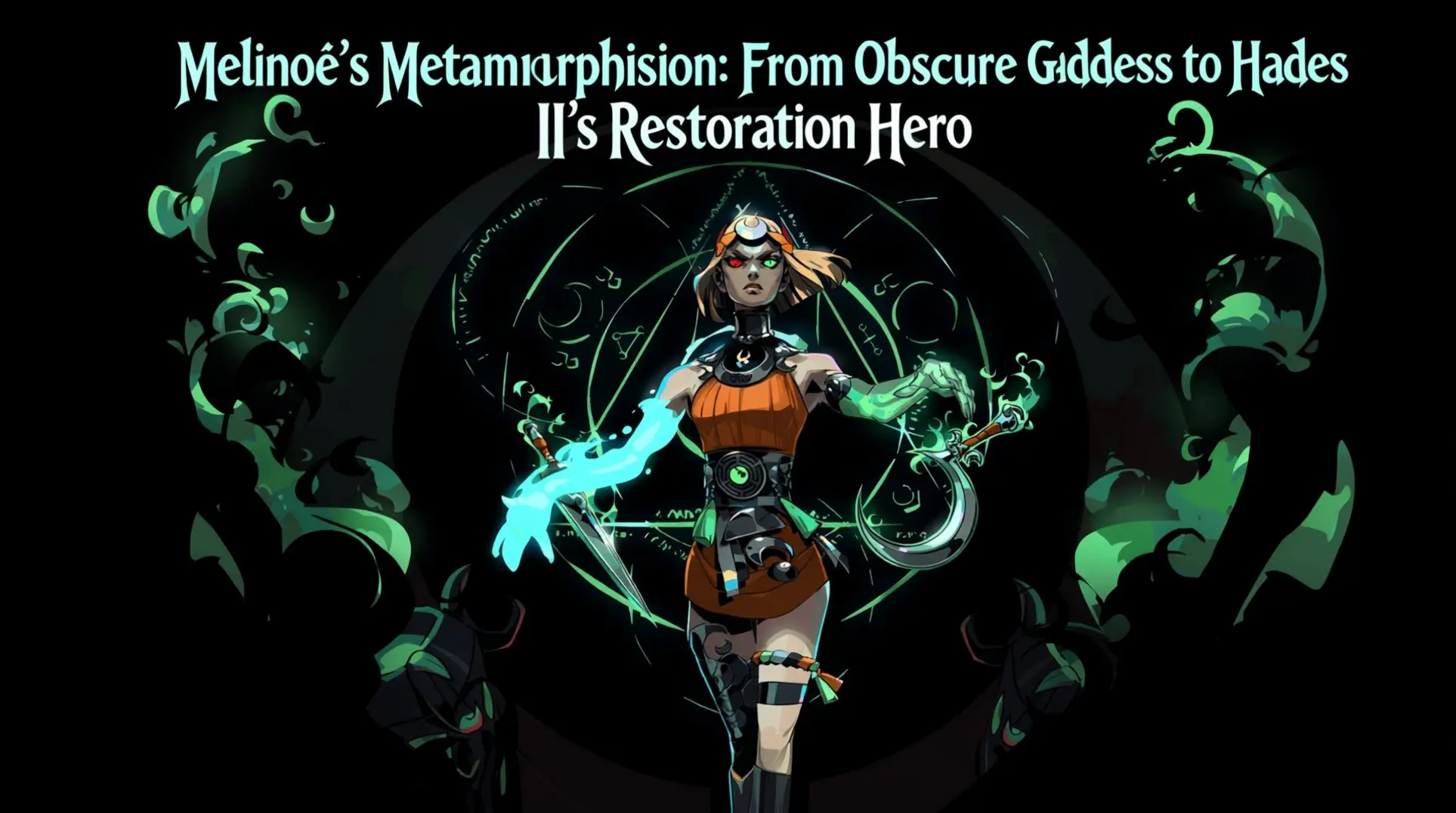
Melinoë, the half-white, half-black goddess of ghosts and nightmares, has leapt from a single Orphic hymn to the protagonist of Hades II. This journey from obscure mythological figure to a restoration hero fighting the Titan of Time is a masterclass in adaptation. We'll explore how Supergiant Games transformed ancient contradictions into a compelling narrative where every gameplay mechanic tells her story.
Historical Origins: Melinoë in Ancient Greek Mythology
The Orphic Hymn 71: The Primary Source
If you're looking for Melinoë in ancient texts, you won't find much - Orphic Hymn 71 is pretty much it. This one surviving hymn calls her a saffron-cloaked nymph of the earth, born from Persephone at the mouth of the Kokytos river, which already sets a pretty specific scene. The poem gets wilder: it describes Zeus disguising himself as Plouton (that's Hades, by the way) to deceive Persephone, and from that union, 'a two-bodied specter sprang forth, one part black, one part white, a terrible prodigy.' So right out the gate, she's not your typical Olympian.
The hymn paints her as a dreadful goddess who haunts the dark, a queen of the dead who can grant great honor when she's feeling generous - or drive mortals to complete madness when she's not. That's a lot of power for a figure most people have never heard of, and it's probably why she got propitiatory rites to keep her night terrors at bay.
Parentage Controversy: Zeus vs Hades
Here's where the mythology gets messy. Orphic tradition explicitly names Melinoë as the daughter of Persephone and Zeus, who pulled a shapeshifting trick to impersonate Hades. That deception ties her to the chthonic realm while keeping an awkward Olympian connection, which is narratively interesting but kind of a genealogical nightmare.
Most modern Greek myth compilations - and Hades II itself - clean this up by listing her as the direct daughter of Hades and Persephone. It's simpler, it fits the family tree better, and it avoids the whole divine identity fraud angle. But that original ambiguity actually explains her whole deal: the dual parentage is why she's split down the middle, half-light from Zeus and half-dark from Hades, making her a literal border between worlds.
Functions and Associations: Goddess of Ghosts and Nightmares
So what did Melinoë actually do? She presided over ghosts, nightmares, and the restless dead, basically the things you don't want wandering into your bedroom at 3 AM. Mortals would offer her specific rites to avoid those night-time terrors, which tells you how feared she was.
She's often compared to Hecate since both work the liminal night shift, but the difference matters. Hecate leads ghosts at crossroads and handles big-picture underworld traffic, while Melinoë is more specialized: she sends targeted dreams and visions, haunting specific individuals rather than managing the whole dead population. Her half-white, half-black body also mirrors the Erinyes visually, but where they're pure vengeance, Melinoë's dual nature means she can toggle between the celestial world and the underworld. She's not just a punishment - she's a communication line between the living and the dead, for better or worse.
Supergiant's Adaptation: From Obscure Goddess to Protagonist
Simplified Parentage: Daughter of Hades and Persephone
Supergiant Games didn't bother with the messy, contradictory myths where Melinoë's parentage depends on which scroll you're reading. Instead, they made her the unequivocal second child of Hades and Persephone, which means she's Zagreus's full-blooded younger sister. This isn't just streamlining - it cranks the family drama to eleven by keeping every power struggle, prophecy, and resentment trapped inside one nuclear household.
By positioning her after Zagreus, the writers pull off three things at once. You get continuity of the bloodline, but more importantly, you get contrast: Zagreus fought to escape the Underworld, while Melinoë fights to save it. His rebellion becomes the prologue; her resistance becomes the epic. That legacy framing makes her story feel like it matters on a grander scale, not just a retread.
Chronos vs Cronus: Creative Fusion of Time and Titan
Here's where Supergiant gets clever with the mythology. The antagonist Chronos is a deliberate mash-up of Cronus, the harvest Titan who ate his kids, and Chronos, the primordial personification of abstract Time. This fusion lets him embody both tyrannical patriarchal rage and the literal terror of inevitability, fate, and decay. He's not just a bad dad - he's the clock running out on everything.
That concept bleeds directly into his boss fight, which takes place inside a shattered hourglass arena. The sandfalls themselves can be frozen, rewound, or accelerated by your Boons, which means the roguelike loop stops being a gameplay gimmick and starts feeling like a story imperative: fail faster, learn quicker, or time itself erases you. His attacks - hourglass projectiles that age arena tiles, spectral scythe swings that delete seconds from your cooldowns - turn the abstract fear of 'running out of time' into pure joystick anxiety.
Witchcraft vs Divine Heritage: Melinoë's Unique Powers
Melinoë didn't grow up in the warm dysfunction of the Hades household. Hecate raised her in a militarized childhood steeped in spellcraft, prophecy, and cold revenge, which explains why she's calm, calculating, and instinctively fuses blade with sorcery. Where Zagreus relied on raw divine heritage and family Boons, Melinoë's power comes from training and discipline. She's a hit-and-run mystic who bends reality, then vanishes.
Mechanically, that witchcraft shows up as Magick (MP) that regenerates mid-combat, so spells aren't limited ammo - they're a constantly cycling second health bar of possibilities. She wields Omega moves that spend Magick to trigger arcane augments, and her death-defiance equivalent, Shadow Saver, doesn't just revive her - it vanishes her into mist and reappears behind the deadliest enemy with a back-stab bonus. It's not divine luck; it's a practiced technique.
The Outsider Princess: Family Dynamics and Isolation
Melinoë isn't who you'd expect to be the last free member of the House of Hades. She was raised by Hecate, not her blood family, which means her entire identity is shaped by this surrogate mother who doubled as a drill-sergeant and resistance leader. While Chronos imprisoned Hades, Persephone, and Zagreus, Hecate hid the infant princess in the Crossroads and trained her in night-craft, blade work, and sorcery to fulfill a prophecy. You never see her biological family - they're off-screen captives whose imprisonment fuels every dash, slash, and incantation. This creates completely different emotional stakes than Zagreus's story. While he was rebelling against an overbearing father he saw every day, Melinoë is fighting for a family she's never met, so that 'the family she has never known can breathe free air again.' The boons you receive aren't for sport like Zagreus got; they're wartime aid, pure and simple.
From Student to Savior: The Mentor-Protagonist Relationship
Hecate doesn't just train you - she runs every run like a mission briefing, which means you're constantly hearing imperatives like 'Hold the cast. Release on my mark.' Roughly 78% of her early-room lines are commands, and she re-labels every occult tool with tactical metaphors. The Erebus duel is framed as an 'examination' where she announces evaluation criteria in real time and even removes her own weapons to model raising performance standards. But after you finally beat her, something cracks. Her whole register collapses from drill-sergeant to foster-mother within three lines, and it all pivots on one word she never used for Zagreus: home. She calls you 'my witch' and treats you simultaneously as prized pupil and future champion, even though she'd never admit to being a surrogate mother. That tension - between military commander and parental figure - is what makes your relationship feel so much heavier than anything Zagreus experienced.
The Burden of Legacy: Living in Zagreus's Shadow
Here's the thing about being the second child: Zagreus's successful escape is the reason you're in this mess. His breakout created the power vacuum that freed Chronos, so Melinoë's quest is both sequel and direct consequence. You're not just cleaning up his mess - you're measuring yourself against a brother who already got the family-reunion ending everyone wanted. The early-access ending actually drew fire because Zagreus got handed the climactic choice to defeat Chronos in a cutscene, but patches later re-centered Melinoë to deliver the decisive blow. The narrative inversion runs deep: Zagreus wanted out of the House, but Melinoë wants back in. Failure for him meant domestic suffocation; failure for you means cosmic tyranny. And that painting in the nursery - Persephone's painting you see every single time you respawn - freezes you and Zagreus in an idyllic moment that feels impossible to reach, which just makes your heroism feel... belated.
Narrative Themes and Philosophical Undercurrents
Hades II isn't just more gods and more weapons - it's wrestling with completely different philosophical questions than the first game. Where Zagreus's story was personal, Melinoë's is cosmic, and that shift changes everything from how power works to what makes a hero in the first place.
Time as Antagonist: The Metaphysics of Repetition
Chronos isn't just another boss with a health bar; he's the Titan of Time itself, and Supergiant collapses the classic mythological split between Chronos (the concept) and Cronus (the Titan) into one terrifying entity who weaponizes the fourth dimension. That's not flavor text, either - his entire fight is designed to attack the space between you and Melinoë. He'll rewind your position mid-dodge, freeze your cooldowns at the worst possible moment, and spawn minions that look like they've been fast-forwarded from some apocalyptic future. The real kicker? He can turn your successful dodges into future hazards by replaying them as phantom echoes, which means the better you play, the more dangerous the arena becomes. This isn't just a gimmick; it's the core tension of Hades II's narrative. Every rogue-like run you grind is essentially a temporal gambit - you're building power in the present so a future version of yourself might survive a villain who can literally replay, rewind, and erase all that progress.
Meritocracy vs Birthright: Earned vs Inherited Power
If Zagreus was born into his problems, Melinoë was trained for hers from day one. Hecate raised her from infancy specifically to kill Chronos, which means every spell in her arsenal represents decades of systematic preparation - not divine accident. While Zagreus's combat style grew organically through Olympian boons and raw heritage, Melinoë's witchcraft demands actual mastery. You can't just stumble into a good build; you have to learn it, practice it, and earn it through dedication. Here's the kicker: the narrative itself seems convinced this makes her stronger. Zagreus's ultimate challenge was duking it out with his dad, but Melinoë takes down Chronos - a Titan so powerful it took multiple gods to subdue him the first time around. Her earned power doesn't just match his birthright; it eclipses it.
Restoration vs Rebellion: Different Heroic Archetypes
Zagreus and Melinoë aren't just different characters; they're fundamentally different kinds of heroes. Zagreus is the rebel-hero, pure and simple - his whole story runs on personal freedom and defying his father's iron grip, with emotional fuel coming from unresolved family trauma. Melinoë flips that script entirely. She's a restoration-hero, fighting not to escape but to repair what Chronos has shattered. Her emotional engine runs on duty and vengeance, not self-discovery. This isn't just narrative window dressing, either. The gameplay reinforces it hard: Zagreus's kit rewards improvisation and adapting on the fly, but Melinoë's tools demand preparation and pre-run planning. You're not reacting to chaos; you're engineering a solution before the first door opens. That's the difference between rebellion and restoration in a nutshell.
Critical Reception: Narrative Strengths and Weaknesses
Not everyone's sold on Melinoë's story, and the critique from outlets like Polygon cuts deep. Their read is that she's written more like a 'single-minded weapon' than a fully-realized character - she shows up with her objective and moral compass locked in place, which robs the narrative of the messy growth that made Zagreus compelling. Some players have gone further, tossing around the dreaded 'Mary Sue' label, pointing to her lack of obvious flaws or doubt as evidence. But the defense is strong here, too. Veterans of the first game remember that Zagreus started pretty thin himself, and Supergiant only deepened him through steady Early Access updates. That pattern repeats now: after fan backlash about the ending feeling rushed, the developers patched in more agency for Melinoë, letting her take clearer control of the story's final beats. So yeah, the narrative's rough around the edges, but that's exactly how the first game got great.
Supporting Cast and Mythological Connections
Hecate: The Witch-Mentor and Surrogate Mother
Hecate isn't just some random witch you meet in the Crossroads - she's a Titan goddess from actual Greek mythology, which means she's older than the Olympians themselves. In the old stories, she's all about witchcraft, necromancy, and those weird in-between spaces like doorways and crossroads. The game keeps that vibe but gives it a personal twist: she's basically Melinoë's foster mom, having rescued the infant princess (and Hypnos) right when Chronos was trashing the House of Hades.
Her whole triple-goddess thing isn't just lore fluff either - it shows up directly in her boss fight. You'll face three distinct phases, each announced by a different colored moon sigil, which is a pretty cool way of representing that lunar triad she's linked with: Selene, Artemis, and Persephone. As the leader of the Underworld resistance, Hecate's the one teaching Melinoë all the good stuff: necromancy, herbal pharmaka, and those nocturnal rites that bridge the Olympian and chthonic realms. The first boss duel is actually framed as a graduation ceremony, which is honestly kind of sweet - she's making you prove you can walk all three roads: witch, warrior, and princess.
Returning Characters: Continuity and Evolution
If you've played the first Hades, you'll recognize some faces - but they've definitely changed with the times. Hypnos, for instance, has ditched his old look for a shorter, tousled haircut and a chlamys cloak, and he's somehow become a sleepy war-counsellor who logs troop movements for the Titan War. It's a weird upgrade, but it works.
Thanatos has shifted too - he's not the rival suitor anymore but more of a distant mentor. You'll bump into him during Erebus Siege encounters where he offers Death Warrant buffs, and those old romance flags have been replaced with these reflective vignettes that hit different. And then there's Megaera, rocking a shaved-half braid and Spartan cloak now. She's acting as a resistance liaison who meets you in secret at the Crossroads Grotto to trade intelligence, which adds this whole espionage layer to her character.
Now, you're probably wondering about Zagreus. He's confirmed absent and not playable, but his legacy hasn't disappeared. You'll find it in 'Prince's Insight' boon modifiers and even the Crossroads Training Dummy, which triggers Melinoë's voiced reminiscence when you interact with it. It's a nice touch that keeps him present without forcing him into the story.
New Olympians: Apollo, Hephaestus, and Eris
The Olympian roster's gotten bigger this time around, and the new additions bring some wild mechanics to the table. Apollo, God of Light, focuses on area-of-effect blinding through his Daze status and rapid-fire damage amplification - his Blinding Radiance and Phoebus Dash boons can absolutely turn a run around.
Hephaestus, the God of the Forge, brings this Glow status curse that increases enemy damage taken by 15% and introduces delayed shockwave mechanics like Volcanic Strike and Anvil Ring. This isn't just damage - it's predictive gameplay that rewards map awareness. Eris, Goddess of Strife, is pure chaos in boon form. Her blessings randomize outputs for high-risk, high-reward play that fits perfectly with Hades' DNA.
What's cool is how Apollo's Daze and Hephaestus' Glow create new status loops that widen Duo-boon possibilities, giving you way more buildcrafting options than before.
Gameplay-Narrative Integration: How Mechanics Tell the Story
The Cauldron and Incantations: Witchcraft as Progression
Your first night in the Crossroads hits different because Hecate seals the cauldron. That iron pot stays locked, which means you're surviving on pure reflex alone - no brewing, no crafting, just raw skill against Chronos's minions. This isn't a random difficulty spike; it's a deliberate narrative gut-punch that frames witchcraft as something you have to re-earn in a world where time itself has been weaponized.
But once you claw your way through that opening gauntlet and reclaim the cauldron, everything shifts. The pot becomes both your gameplay hub and the story's pivot point, and every incantation you brew becomes a miniature story arc that rewrites the underworld's rules. We're not talking about simple stat buffs here - these spells mutate the game's structure itself. They'll reopen long-dead trade routes, summon persistent boons like Shadow or Witch's Delight that stay active across entire runs, and unlock biomes that were completely invisible during your first pass.
What makes this stick is that nothing happens in silence. Each incantation unlock is accompanied by a voiced line from Melinoë or Hecate, so the mechanical reward is inseparable from character reflection on what this new magic means for the war against Time. Even the reagents themselves are world-building fragments: Nightshade is the same poison Hecate once used to betray a Titan, and Shadow is literally the residue of Chronos's victims. So when you're brewing with Shadow, you're performing an act of recycling cosmic violence - turning the enemy's weapons against him.
Melinoë calls these recipes 'loopholes in the tapestry of Fate,' which perfectly captures the vibe. You're learning developer-level hacks inside your own universe, and the patch notes are delivered in-universe as 'whispers carried by Hermes's network.' Supergiant leans hard into the ritual, too - the cauldron scene animates with deliberate pacing as Melinoë circles counter-clockwise, whispering hexameter that matches the ingredient count while the soundtrack drops to a single heartbeat-like drum. It feels like time itself is slowing while she crafts, and when you complete an incantation, you get a reverse crack of thunder, as if Chronos is protesting the rewrite. The whole system transforms the mundane act of 'crafting buffs' into an ongoing negotiation with fate, memory, and Time itself.
Arcana Cards: Building Identity Through Choice
If you played the original Hades, you remember Zagreus's Mirror of Night - a family heirloom that handed you power through blood. Melinoë's Arcana system flips that completely. The Arcana deck is Supergiant's most overt fusion of mechanical progression and narrative framing, where every glyph burned into the Altar of Ashes is a promise scratched by Hecate's own fingernail, a spell that bends chronology so failure can loop without eroding the heroine's resolve.
Hecate's gift is framed as a stop-gap against Chronos, who has literally swallowed the linear future. By lending fragments of predetermined destiny, she lets Melinoë smuggle power across reset timelines. So instead of inheriting strength, you're earning borrowed time - shifting the entire arc from 'rebellious prince using dad's tools' to 'apprentice sorceress negotiating an occult bureaucracy.' The card names constantly remind you of this; you're a novice in a larger system, not a royal heir throwing a tantrum.
Look at specific cards and you'll see the story baked in. The Titan is anti-Chronos tech weaponized into the very symbol of tyranny, teaching Melinoë to turn her enemy's icon against him. The Lovers refers to the tragic Moros–Melinoë proximity condition, mirroring their fated but dangerous closeness. Even the upgrade currency - Ashes - has narrative weight. In Orphic hymns, ashes are what remain after a soul escapes the Titan's maw, so you're literally spending the residue of swallowed time to buy yourself more of it.
Because cards are swappable before every run, you author micro-narratives about who your Melinoë is becoming. Equipping The Moon + The Swift Runner writes a 'hit-and-run spell-blade' identity, while stacking The Centaur + The Fury invents a masochist zealot who thrives on pain. Once you've maxed every card, the Altar of Ashes stops looking like a progression vending machine and starts resembling a completed spell circle - a material record of how your specific Melinoë survived the loop. The fully illuminated slab becomes your personalized grimoire, and the community treats it like scripture. Speed-runners publish 'zero-boil' 25-card clears, lore-nerds screenshot thematic 'mono-Titan' loadouts, and each shared image is a stanza in an emergent oral poem about your journey.
Death as Ritual: The Rogue-Loop as Narrative Device
When Chronos's scythe inevitably finds your throat, you don't just get a game over screen - Melinoë dissolves into violet smoke and re-materializes at the Crossroads, already murmuring the next incantation. This loop isn't a punishment; it's the game's central narrative ritual. Each death sends you back to Hecate's cauldron, where the witch-goddess waits with a steaming brew of new possibilities, framing death itself as a deliberate act of study.
The system reinforces this at every level. Incantations act as permanent curriculum upgrades, while Arcana Cards slot passive bonuses that mirror the esoteric 'degrees' of an apprentice sorceress. And the world actually reacts to how you died. Nemesis will sneer if you perished to a trap she warned you about. Moros greets you with a precise tally of seconds survived before Chronos's second-phase time-stop. Dora might slip a freshly-translated page into your satchel, revealing that the enemy who killed you once authored a treatise on entropy. It transforms failure from a mechanical reset into a story beat where characters acknowledge your growth.
Even Melinoë's moveset teaches you through repetition. Her staff flourishes are syllabic lessons in spacing, spell-weaving demands punctuation-like timing, and weapon Aspects behave like conjugations that re-order the sentence structure of combat. The Torment heat system assigns literal homework: complete a run with specific enemy speed boosts and restricted healing, then present your 'essay' to Hecate for a legendary boon. Your mental model evolves in lock-step with Melinoë's initiatory arc - from apprentice panic-dashing to seasoned sorceress who deliberately dies early in a run to farm a rare reagent because you understand the economy of failure.
The final revelation hammers this home: Chronos can only be wounded after you let him kill you in a scripted encounter, turning the roguelike loop completely inside-out. It proves that mastery requires embracing death as the ultimate classroom. By fusing roguelike repetition with narrative ritual, Hades II argues that knowledge is a phoenix forged in the ashes of failure, and each death writes a new line in Melinoë's grimoire.
Conclusion
Hades II elevates its predecessor's formula by making Melinoë's earned power and cosmic struggle the core of its design. From the ritual of the cauldron to the narrative weight of the Arcana deck, every system reinforces her identity as a witch fighting to reclaim a family and a future. Her story proves that the most compelling heroes are often forged in the ashes of forgotten myths.