The Ultimate Guide to Trade in Pioneers of Pagonia: Mastering Logistics, Diplomacy, and Empire Building
Introduction
Mastering trade in Pioneers of Pagonia is the key to uniting the archipelago and building a thriving empire. This isn't a simple click-and-forget system; it's a complex web of logistics, diplomacy, and resource management that forms the backbone of your entire campaign. This guide will break down every layer, from scouting factions to optimizing naval routes, so you can turn scattered islands into a powerful, profitable network.
Foundations of Pagonia's Trade System
The Archipelago Economy: Why Multi-Island Trade is Essential
You're not building a single city in Pioneers of Pagonia - you're running a full-blown archipelago. Each island is basically its own ecosystem, locked behind procedural generation and packed with distinct resource nodes and factions, which means you can't just plop down a few mines and call it a day.
The whole campaign revolves around reuniting these scattered islands, and there's a practical reason: you can trade between them to access specific rare items, though the complete roster of more than 100 commodities is available through production chains on your starting island. No single landmass has everything - Island A might be swimming in iron but starved for fertile soil, while Island B has the perfect clay deposits for bricks but zero copper.
This creates a natural dependency, so you can't finish complex production chains without looking beyond your shores. That 'reunite Pagonia' objective isn't just lore fluff; it's the economic backbone of your entire operation.
- Mountain Peak Settlements: Your go-to for ores and stone, but don't expect to grow much food
- Tropical Paradises: Spices and rare plants, yet good luck finding a single coal vein
- Neutral Faction Territories: Often gatekeep unique resources until you establish trade relations
Visible Logistics: The Settler-Powered Transport System
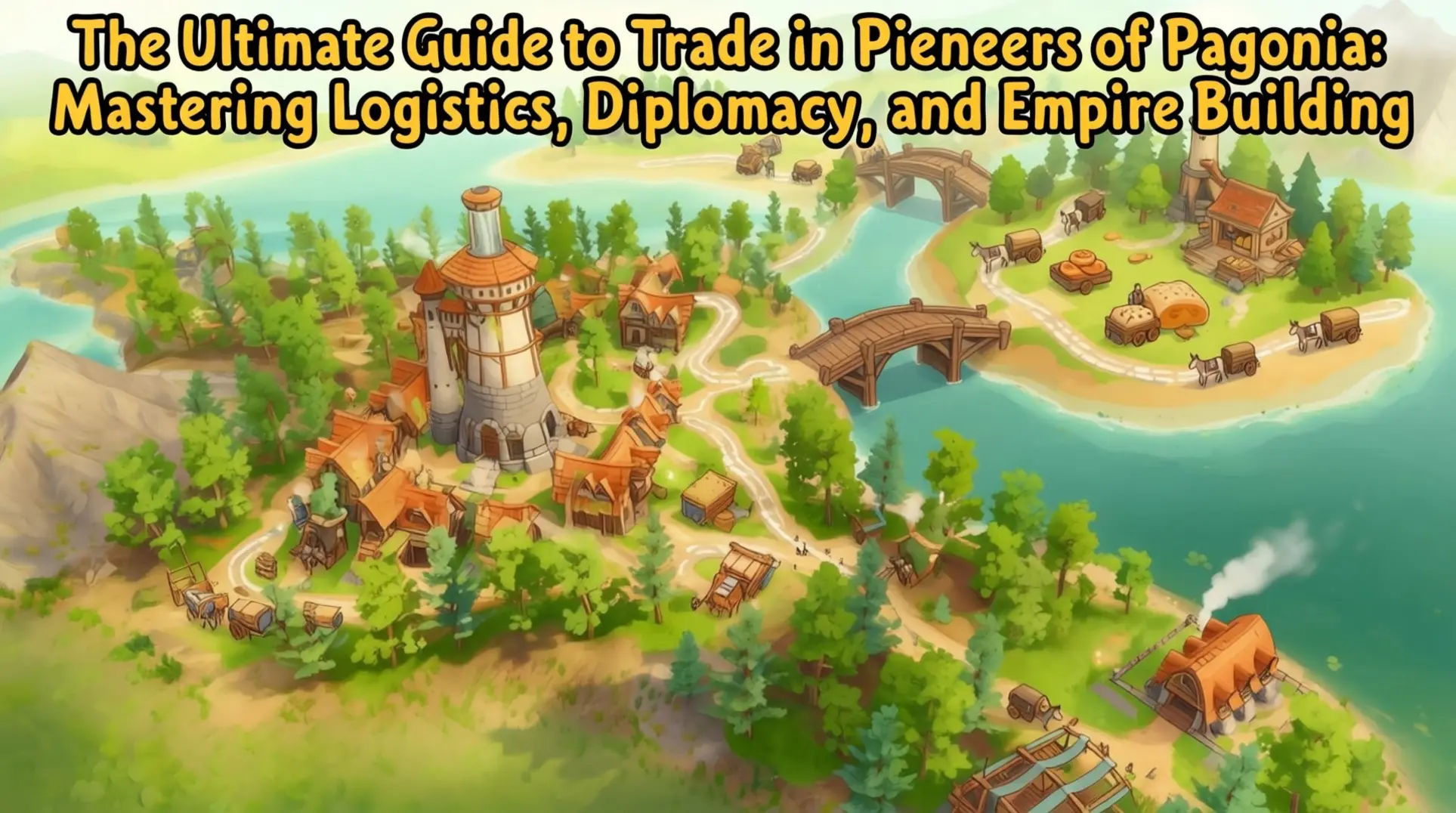
Here's where Pioneers of Pagonia gets its soul. Every single item - log, loaf of bread, or trade good - is physically carried by settlers. The Germans call it the Wuselfaktor, which roughly translates to 'swarm factor,' and it's exactly what it sounds like: a living, breathing ant colony of tiny workers buzzing around your empire.
Trade isn't an abstract line on a map. When you establish a route, actual Trade Carrier units—individual adult humans produced from Newborn settlers—walk the entire distance on land. Boats are created separately at a shipyard for water crossings, while porters are upgraded units created in a Tool Workshop.
Route planning becomes a game of physical logistics. You can't just think 'connect A to B.' You need to account for path length, how many carriers can fit on that road, and whether they'll bottleneck at a narrow bridge, so a 30-second harbor crossing with one boat means your entire chain runs at that boat's pace.
The cool part? That visible traffic is your best diagnostic tool. If you see a traffic jam outside your smithy, you immediately know it's starved for iron. No spreadsheets required - just watch the swarm.
But there's a catch. Your carriers share a global pool, and once you hit that cap, production just... stops. Workshops can't output, trade routes dry up, which makes strategic warehouse placement non-negotiable. You need distribution hubs close to production clusters, and you'll want those cart upgrades ASAP to squeeze more throughput from each settler.
The visible logistics system turns abstract economy into something you can see and feel, which means your mistakes are obvious - and so are your triumphs.
Diplomacy & Faction Management for Trade
Discovering and Scouting Neutral Factions
You won't spot any factions on day one. They only emerge from the fog as your pioneers push into new territory, and here's the key thing: once they show up, their turf is locked forever - no expansion, no shrinking, just a fixed slice of the island that never changes. That means wherever you discover a tribe is exactly where they'll stay for the entire campaign.
To make first contact without starting a pointless war, slap down a Watchtower right next to their village. This 'tags' them for negotiation instead of combat, which is crucial because fighting tribes just burns resources you could be using for trade.
Your path-finding pioneers are what make this whole system work. Every fresh sector they explore peels back the grey shroud and rolls the dice on whether a tribe spawns there, so keep sending them deeper into the unknown.
Building Friendship: Gifts and Trade Volume
Alright, you've found a faction - now you need them to actually like you. There are two ways to grease the wheels, and you'll want to use both.
First up: gifts. When a faction asks for a specific item, hand it over at their settlement or a Mysterious Location and you'll get a one-time relationship points boost based on the gift tier: Small gifts provide +5, Medium gifts provide +10, and Large gifts provide +20.
Then there's trade, which is where the real work happens. Each successful shipment adds relationship points based on context: normal shipments yield +1, high-value shipments yield +2, and crisis deliveries or first-time luxury goods introductions yield +4. The math works out to roughly 13 to 14 optimized trade runs plus your initial gift to reach 100% friendship, which flips a neutral faction to 'Friendly'.
So the play is: one gift gets you a third of the way there, then keep the carts rolling with decent goods until they trust you.
Faction Specializations and Resource Availability
Now for the part that'll shape your whole strategy. Every faction is locked into a fixed trade grid of 8 items from the moment you generate your map. You cannot re-roll it, you cannot change it - that's their entire inventory, period. If a tribe doesn't sell iron ore when they spawn, they never will, so scouting the right partner is everything.
The prices are just as rigid. We're talking a completely symmetrical system where trade is conducted via fixed quotas of goods, and it doesn't matter if you're trading with the mountain clan or the forest people. There's no arbitrage, no haggling, no clever market plays - the price is the price.
Your entire game plan becomes: find the faction that spawns with the grid you need, befriend them fast, then feed them cheap wood or stone to pay for the valuable stuff like iron ore or tools. It's less about being a trading genius and more about being a smart scout - locate the right partner early, and you're set for the whole campaign.
Naval Transport Infrastructure Setup
Setting up naval trade in Pagonia isn't just about slapping down a dock and hoping ships show up. There's a whole system to wrap your head around, from finding the right coastline to making sure your carriers aren't stuck in traffic jams.
Building and Placing Trading Posts
First things first: you can't just build a Trading Post anywhere and call it a day. The game makes you hunt for a specific spot, and you'll know you've found it when that teal anchor icon appears - that's the visual thumbs-up that ships can actually moor there. It only shows up when you're hovering over coastline sediment inside your territory that touches deep blue 'Open Sea' tiles, so no cheating with little ponds.
The plot itself needs to be clear sand or grass, which means chopping trees and blasting rocks out of the way first. Luckily, you don't need to connect a road before placing the building - the Trading Post comes with its own invisible quay baked in. Once construction finishes, you'll see a little pier pop up, and you're officially open for naval business.
Here's the sneaky part: if you want multiple convoys running to the same trade partner, just stack another Trading Post. Each one operates independently, so you can run parallel routes and really pump up your trade volume.
But a Trading Post without carriers is just an expensive decoration, so let's talk about where those people actually come from.
Trade Carriers: Hiring, Limits, and Management
This is where most players hit a wall. Trade Carriers don't magically appear - you've got to grow and train them. They start as Newborns in your family houses, mature into generic Carriers, but here's the kicker: they need a Backpack from a Tailor's Shop plus re-training at a Guild Hall before they can haul a single crate. You're looking at a whole production chain just to staff one route.
Each Trading Post caps out at 25 carriers, which feels generous until you're running three routes with convoys departing every minute. If you hit that ceiling, your only fix is building another Trading Post - each one gets its own fresh 25-carrier quota.
The real bottleneck is your population pool, though. Those same Newborns you're banking on for trade? They're also your future Diggers, Builders, and Soldiers. If you don't expand housing before you expand commerce, you'll be waiting forever for enough kids to grow up and fill those Backpacks.
Now that you've got your people, you better make sure they're not wasting half their lives on dirt roads.
Road Network Optimization for Trade Routes
Stone roads are non-negotiable if you want efficient trade - they give carriers a 20% speed boost, which means more round-trips per day and fewer total carriers needed to keep routes humming.
The real pro move is warehouse spacing. You want them about one full residence grid apart (roughly 7 tiles), so carriers hand off goods at the halfway point. This keeps each leg of their journey under the default 9-tile carry radius, which means no wasted drop-offs mid-route.
For dense districts, run a stone 'spine' through the middle and branch off with dirt roads to individual buildings. But watch out for two-way intersections on high-traffic segments - when things get busy, pathfinding recalculations can actually erase that speed bonus you worked so hard to build.
Creating and Managing Trade Routes
Getting trade routes up and running in Pioneers of Pagonia feels like cracking the code on the game's real economy. It's not just clicking a button - you've got to earn it first, then babysit the logistics. Here's how to turn those neutral factions into your personal supply chain without pulling your hair out.
Step-by-Step Route Creation Process
First, you need to find someone worth trading with. Send a Scout to poke around the fog until a neutral faction pops up, then check their Wants/Offers list - this is your shopping list. If they're desperate for tools and you've got planks to spare, you're in business.
But you can't just waltz in. You need to butter them up. Build a warehouse exactly one road segment from your border and stockpile 20-30 units of whatever they want. Head to the Transfer tab and start gifting - this pushes your reputation up. Once you hit +30 (Friendly) and the green bar appears, the trade treaty unlocks. That's your cue to slap down a Trade Post, which auto-snaps to the nearest valid path on your side. Don't forget to assign at least one free pioneer as a trader in the Staff tab - no staff, no carts.
Now the fun part: in the Routes tab, pick your Export good from the warehouse and Import good from the faction, then set your target stock levels. Click Activate Route and watch a tiny cart make the trip once per in-game day. The trick is keeping your export good in surplus; if you run dry, your reputation tanks. Hit Allied status and you can add a second route. Get to Trusted and a third opens up. Each tier means more lanes, more profit, more problems.
Cargo Mechanics and Throughput Optimization
Here's what the tutorial glosses over: carriers only hold one item at a time, and every flag or warehouse has an 8-slot 'carrier stack.' If those slots fill up, incoming carriers bounce like a rejected package. To keep things flowing, limit production building outputs to ≤6 stacks at any single flag - this reserves two slots for raw materials.
You can cheat distance by placing a second flag one tile farther along the road. This creates a separate 8-slot buffer, doubling capacity without hiring extra carriers. Trade Carriers have a hard maximum walk distance of 15 tiles for a single-leg trip; if the distance exceeds this, the route cannot be established. For regular carriers, throughput is affected by carrier count and supply chain bottlenecks rather than a specific tile threshold. The solution? Plant a mini-hub - warehouse + market + well - every 14-16 tiles along your main artery. This keeps round-trips under 70 in-game seconds and prevents settlers from refusing to migrate past 18 tiles from food.
For mines and quarries, plop a 1×1 micro-warehouse (64 slots) right next to them. This stockpiles 200-300 raw materials and eliminates 80% of empty return trips. And if you upgrade a warehouse to level 2, it gets an internal cart that acts like a temporary donkey, doubling transfer speed for items within 6 tiles.
Oh, and raids target flags first. If you've got a critical flag, ring it with two spares so raiders have to chew through three buffers before they hit your main line.
Advanced Route Strategies: Dual Routes and Automation
Once you've got the basics, it's time to break the system. Research Trade Logistics (tier-2 tech) to remove your default carrier cap entirely, allowing unlimited carriers per route. Build two Trade Posts on opposite sides of your territory to create nodes for dual routes. Produce surplus Trade Carriers (one lodge per three carriers) and set the home building to '∞' to keep replacements spawning automatically.
Here's the pro move: dual-route theory. Route A exports pottery at dawn; Route B exports jewelry at 50% dawn. The staggered departures keep the goodwill timer rolling continuously, so you never hit a lull. Two independent incoming offers also let factions list fresh import requests twice per cycle, effectively doubling throughput without a reputation penalty.
The infinite carrier trick is janky but works: open the Trade Post panel, set Desired Amount to zero, click ∞ once, then immediately set Desired Amount to 999. The game latches the infinite flag while keeping the numeric value. In the Advanced Stockpile tab, set Export Buffer at 5% above equilibrium and Import Ceiling at 80% warehouse capacity to trigger a 30% sell-off to traveling merchants.
For hard maps, queue 6-soldier squads at 25% route intervals for micro-escorts, and station a Scout Tower at the halfway point to pre-load bandit AI. The ultimate play? Mass-produce Jewelry: import cheap Raw Gems and Gold Ore from two factions on dedicated dual pairs, then sell finished jewelry to a third distant faction. That's how you convert surplus into victory.
Resource Management for Profitable Trade
Early-Game Trade Cheat Sheet
Early trade in Pagonia isn't about getting rich - it's about plugging holes while your economy bootstraps. You can't just sell everything or you'll starve your own production, so here's what actually works.
Logs are your safest export, but only after you've got two fully staffed Forester Lodges or a renewable tree farm online. The AI always pays a premium, which means you can treat logs as your emergency piggy bank once you're sustainable.
Berries are pure profit once you've built a six-basket Berry Gatherer and stashed 40–50 in reserve for your food chain. They're fast, free, and abundant, so anything beyond that buffer is free gold.
Planks are dangerous to export early. Don't even think about it until two Sawmills are running triple shifts and you've stockpiled at least 120 planks, because you'll burn through that many just building Barracks, Pier extensions, and your Toolmaker. It's better to have a surplus than stall your entire settlement.
On the import side, clay is a steal at 0.7× your local price. Buy enough to rush three Brickworks instead of building a second Clay Pit, which frees up settlers for logging or berry duty. If your starting island lacks ore nodes, import ore instead - the math is solid: 40 ore becomes 20 iron, which becomes 10 tools that re-export at double what you paid.
Once you hit 90 population, gold ore becomes your best friend. Convert 20–30 ore into iron bars, then into 60–80 gold coins. Use those coins to buy higher-tier goods instead of building expensive production chains yourself.
One critical tip: set warehouse upper limits or your economy will choke. Cap logs at 120, planks at 80, stone at 50, berries at 40, and clay at 30. This stops your Sawmills from hoarding while your Toolmakers sit idle.
Mid-to-Late Game Trade Economics
Once your settlement is stable, trade becomes a money printer. The pivot is simple: you stop surviving and start dominating.
First, you need to unlock high-value exports. Grind reputation with a faction that owns a Mana Forge or Gemcutter's Guild until you hit 'Friendly' status. Once unlocked, magic weapons and enchanted jewelry stay on that faction's offer table forever.
Luxury imports only appear after you activate three Mysterious Places - stone circles, ancient lighthouses, whatever - and connect them to your road grid. You buy these with gold and use them as high-value barter chips, which means they're more currency than commodity.
The production chains are where profit lives. For magic weapons: Mana Forge combines Mana Crystals, Iron Ingots, and Hardwood Grips into Magic Swords. Place your Carpenter directly next to the Mana Forge to cut hauling time by 35%.
For enchanted jewelry: Gemcutter's Guild turns Polished Gems, Gold Leaf, and Arcane Thread into Enchanted Rings. One Lapidary can keep three Gemcutters busy, so plan your worker ratios accordingly.
Here's the real trick: triangle trade. Buy Luxury Imports for around 180 gold, gift them to a 'Wanted' faction for 22–25 reputation plus 1.2× gold barter credit, then buy Magic Weapons at 0.9× gold effective cost. This nets you a 55% profit margin while building diplomatic power.
To fuel this, you need Mana Crystals. Conquer bandit-controlled mountain tiles and build Crystal Mines on them - each produces 0.25 crystals per day, but you have to clear the camp first.
Warehouse Management for Trade Efficiency
Here's where most trade routes fall apart: warehouses have a stock limit that is configurable via a slider. Once you hit that ceiling, upstream production halts completely. You can fine-tune this limit to free up space and restore production flow.
The only way to enlarge your buffer is to build more warehouses or specialized storage, because each new unit contributes its own independent cap. Two or three warehouses next to a final workshop keep it producing overnight, which means your trade goods keep flowing even when you're not watching.
Trade routes follow the same rule. 'Accept only' filters can control what enters a warehouse, but they can't override the fixed limit. A Trade Store stops requesting an item as soon as its warehouse hits the internal maximum, even if you want more.
When a building idles with 'output full,' check the warehouse next door. If its bar is maxed, either build another warehouse or temporarily shuttle excess goods to a distant one with carriers.
On maps with rare trade partners, pre-stockpile export goods across multiple warehouses. All surplus warehouses will empty simultaneously when the trader arrives, which lets you sell far more than a single warehouse's cap in one visit. This is crucial for hitting big reputation milestones or cashing in on premium prices.
Troubleshooting Common Trade Issues
Route Stalls and Carrier Issues
If your trade route is just sitting there with zero movement, you're probably hitting the carrier cap. Every Trading Post has a soft limit of 15 Trade Carriers, which means once you've got 15 employed, that post stops hiring no matter how long you wait. You can check this by opening the Trading Post panel - if Employed equals Capacity, you've maxed out, and you'll need to plonk down a second Trading Post to squeeze out another 15 slots across your empire.
But here's the catch: even if you have capacity, you still need free adults. If every single settler is locked into a job, the Trading Post can't hire anyone. When that happens, you'll have to temporarily disable some non-essential jobs - maybe pause your extra Weaver or Potter - and watch the Ready-for-new-tasks counter jump within seconds. Once it does, manually assign 5-10 carriers to the new post, hit Re-validate, and your route should kick back to life.
Sometimes the problem isn't your carriers but your goods getting hijacked. Guild Halls and Storehouses love hoarding export items, which means nothing ever reaches the Trading Post. You can fix this by locking the item in those buildings and forbidding internal storage, forcing the goods to flow where they're actually needed.
And don't forget the silent killer: a single broken road segment between your Trading Post and the faction gate will block hand-offs entirely, even if everything looks fine. Hover over the route and watch for red flags or dots - those indicate a break. If all else fails and you're just starved for workers, slam down a few extra Homesteads; babies mature into unemployed adults in about five minutes, giving you fresh hires.
Diplomatic Problems and Route Cancellation
Nothing stings like a faction suddenly turning hostile and ripping up your trade contracts. When a faction's invisible reputation dips below the hostility threshold, all active deals get axed instantly. You can't see the exact number, but you'll know it happened when the trade hub vanishes from your map.
Reputation tanks for a few reasons: letting quest timers expire, refusing or aborting a trade request, or building and harvesting inside territory the game secretly marks as theirs. Even worse, hostile fauna like boars can scare your Trade Carriers inside foreign forests, and the engine blames you for endangering the route - yep, you get the rep hit.
Once you're hostile, the foreign trade hub is hidden, so you'll need to send a scout to re-discover it and trigger the friendship quests again. From there, grind repeatable delivery quests; each one grants a fixed chunk of reputation until the dot flips from red to grey. If no quests are available, you can still create a one-way gift through the trade panel - every tiny delivery nudges the meter toward neutral.
Oh, and if a trade post is stuck showing Segments delivered: 0 and Being transported: 0 for more than a full day, just save and reload. It's a bug, and a quick restart forces the engine to recalculate the route.
Infrastructure and Connection Problems
Your Trading Post must be directly connected to the trade point - that little flag or pier on the map edge - by a continuous road. If there's any break, even one hex, the hand-off fails. Hover along the path and look for red flags or dots; those indicate a disconnection. The building also needs to be on land, not water, and the entrance hex has to touch the road, so rotate it if needed.
Goods won't move unless they're physically inside the Trading Post's own storage. A slick workaround is building 1-2 small storages next to the post, setting them to gather only the desired item, then switching them to empty and raising the input priority. This forces warehouse haulers to top up the Trading Post reliably.
If you're swapping trade goods and nothing moves, try pausing and un-pausing the offer, or briefly switch back to the old good until internal storage stabilizes - this can clear a bugged state. And if you've got 16 idle traders who refuse to assign, temporarily remove then re-add the Trade Carrier job slot. You might also need to disable slots at your other Trading Posts temporarily, so they stop stealing the workforce while the new one fills up.
Advanced Multi-Island Empire Strategies
This is where empires are made or broken. Multi-island trade in Pioneers of Pagonia looks simple on the surface, but the difference between a thriving network and a logistical nightmare comes down to three things: smart hub design, proper security, and tech timing.
Building Efficient Trade Networks
Don't make the rookie mistake of slapping down one Trading Post and calling it a day. A single post will choke your entire economy because the game always picks the closest Trading Post by straight-line distance - not by road length - which means high-volume goods pile up while distant contracts get assigned to the wrong building. You're left staring at 'Occupied' statuses and wondering why your gold river has dried to a trickle.
The fix is brutally simple: build two or three Trading Posts, which splits the job pool and forces the algorithm to spread contracts around so your caravans aren't running marathon loops for every single trade.
Now let's talk hub-and-spoke. Create a main hub right inside your production cluster with one Trading Post and a Trade-Carrier building (it holds 25 carriers). Then build a forward hub within 25 tiles of the foreign faction's depot - yes, count those tiles - and duplicate the setup. Connect both hubs to your warehouse network with paved roads so carriers can resupply in both directions without standing around picking their noses.
Before your first caravan even spawns, queue 30-50 Tailor-made backpacks at your Tailor. If you don't, you'll see 'Trade Carrier: 0 available' even with a fully-staffed Trading Post, because every carrier needs a backpack to haul goods. If they're sitting idle despite having backpacks somewhere, use the Move command to manually transfer them into the warehouse linked to your Trading Post.
Here's a nasty trick to bias the algorithm: store high-value exports like shovels, swords, or jewelry only in the warehouse feeding your forward post, while keeping low-value bulk - logs, bricks, stone - near your main hub. This pushes the game toward assigning luxury trades to the nearby forward post automatically.
If the game still picks the wrong post and shows 'Occupied, Segments delivered: 0', just pause the distant Trading Post for 10 seconds and the contract immediately reassigns to the nearer one. It's cheating, but it works.
For mid-game scaling, a single trade-carrier building supports 25 merchants, so with 6-8 active contracts, drop a second carrier hall next to the same post to hit 50 capacity. This boosts caravan frequency by roughly 40% without building a whole new hub.
Late-game on large maps uses a triangle setup: a North Post for ore, tools, and weapons; a South Post for food, herbs, and luxury; and a Core warehouse cluster buffering surplus for rapid refills. With 2 × 25 carriers, you can sustain 12-14 active routes pulling 800-1000 gold per day while keeping factions at Allied status.
Defending Trade Routes from Bandits
Bandits love your trade routes more than you do, and every successful raid slaps you with a relation penalty while forcing you to re-establish the route from scratch. Thieves come in three flavors: Thieves, Cunning Thieves, and Master Thieves, with the latter two dodging patrols and fighting longer when cornered.
Before you can even establish a route, you must clear every hostile unit from the area around a discovered faction, because the 'Establish Trade Route' button stays grayed out while enemies sniff around the depot.
Once running, defense is about layers, not luck. Place Guard Towers at road intersections and trade crossroads - they give 360° vision and hold one Ranger each. For critical chokepoints, build Garrisons at your town gate and directly next to the foreign faction depot. Garrisons hold three Rangers, have higher HP, and outrange towers, which creates a secure bubble at both route ends.
Build an Adventurer's Guild early and never stop queueing Rangers. On hard maps, assign one Ranger per tower or two per Garrison for 24/7 coverage. Then hold Shift and click road tiles to set patrol flags between your Trading Post and the faction building; Rangers will walk the exact caravan path, which dramatically raises interception chances.
Research Torch at the Guild to increase tower sight radius - earlier engagement means less caravan damage. Keep a Storage Barn within two road tiles of every frontier tower, because Rangers abandon posts when they run out of food or tools.
If a bandit destroys a tower, rebuild it instantly. A one-minute gap lets Master Thieves slip through, cancel your route, and tank your reputation.
Campaign tip: On Map 4, clear only the first northern tree block with Warlock Apprentices, then immediately establish a trade route to buy Wise Warlocks (20 damage each). Use them to clear the remaining bandit camps and turn the trade route into an offensive supply line.
Tech Tree Synergies for Trade
The single biggest trade upgrade is Improved Packaging, which requires around 80 population and roughly 150 Knowledge at the Library after you grab Basic Trade and Caravan Logistics nodes.
This tech increases the stack size of all goods by +4, which translates to an effective ~20% capacity increase per carrier, resulting in fewer trips and effectively faster delivery throughput.
Pre-tech, buying clay at ≈3 gold and selling glazed pottery at ≈18 gold nets you 90 gold per mule after costs. Post-tech? You're pulling 135 gold per mule - a +50% margin increase.
Before Improved Packaging, you needed three mule trains to supply a distant Copper Tribe with linen clothes. Afterward, two suffice, which frees labor and beasts for other hauling jobs.
The tech synergy is real: Reinforced Wheels (-20% terrain speed penalty) pairs perfectly because faster movement multiplies the value of that extra cargo space.
Diplomatic Gifts research opens 'Gift Bundle' orders at the Trading Post, and when combined with Improved Packaging, you can shove double gift baskets into a single caravan for accelerated friendship gains.
Add Tar Roads infrastructure for just-in-time supply chains where raw goods arrive the same day they're needed, which slashes inventory overhead.
After Improved Packaging, prioritize Peptide Research and other carrier efficiency techs to further slash travel times and boost throughput.
One warning: the Trading Post has finite storage. Larger caravans can fill its yard faster than merchants depart, causing goods to spill and decay on the ground. Don't overstock the post itself - keep surplus in adjacent warehouses.
Conclusion
Building a successful trade empire in Pagonia requires a blend of strategic foresight and meticulous logistics. From managing your carrier pool and defending routes to leveraging tech synergies, every decision impacts your economic engine. Master these systems, and you'll transform the archipelago's natural dependencies into a source of immense power and prosperity.
More pioneers-of-pagonia Guides
Mastering Pioneers of Pagonia: The Ultimate Guide to Logistics, Ratios, and Traffic
A complete guide to Pioneers of Pagonia's complex production chains. Learn optimal ratios, micro-hub placement, traffic management, and troubleshooting to keep your settlement running smoothly.
Ultimate Guide to Resource Management in Pioneers of Pagonia
Master crop yields, mineral extraction, and advanced strategies to build a thriving colony in Pioneers of Pagonia. Avoid common pitfalls with this comprehensive guide.

Mastering Tribe Diplomacy in Pioneers of Pagonia: The Complete Guide
A comprehensive guide to mastering tribe diplomacy in Pioneers of Pagonia, covering trust meters, quests, alliances, and late-game strategies.
AI Tactical Companion
Consult with our specialized tactical engine for pioneers-of-pagonia to master the meta instantly.