RimWorld Crafting Guide: Mastering Components, Materials, and Textiles
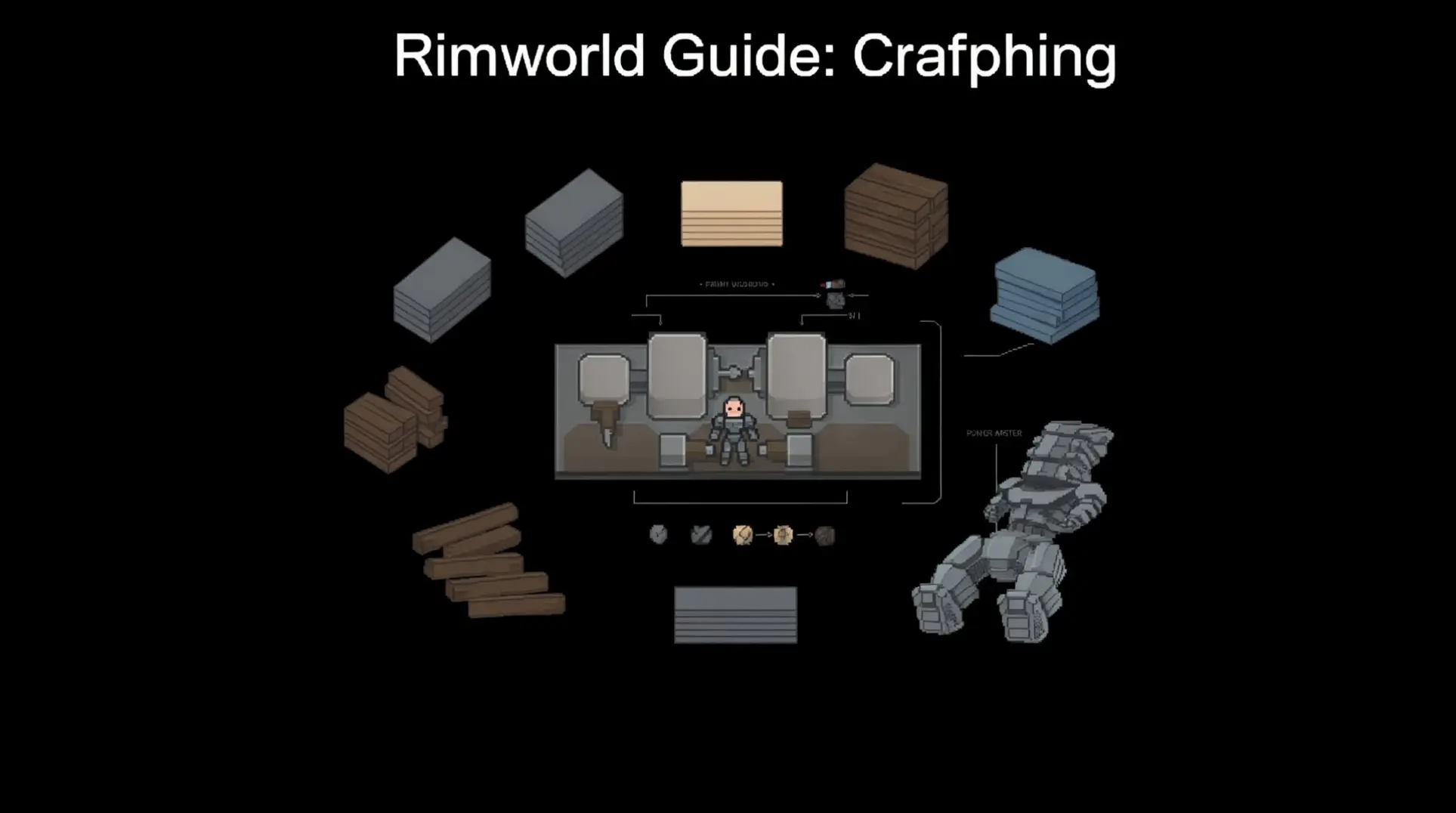
In RimWorld, mastering the intricate crafting system is essential for transforming your fledgling colony into a technological powerhouse capable of surviving the harsh realities of an unforgiving planet. Components serve as the lifeblood of technological progression, required for everything from basic electrical devices to advanced weaponry and the ultimate goal: building a starship. Materials like steel, plasteel, and specialized textiles determine the durability, protection, and efficiency of your colony's equipment, while medical resources like neutroamine can mean the difference between life and death for your colonists.
Acquiring Components: From Mining to Fabrication
Mining Compacted Machinery
The most straightforward method for acquiring Components is by mining Compacted Machinery deposits. These valuable deposits appear as brown-hued nodes, typically found within mountains or hills.
- Each successfully mined tile from a deposit will yield 2 Components.
- These deposits usually appear in small clusters, ranging from 3 to 6 tiles in size.
For finding larger quantities, you can use the long-range mineral scanner. This advanced technology can locate distant lumps of Compacted Machinery. Each of these large deposits can yield over 100 Components, providing a significant boost to your resources.
Trading for Components
When local mineral deposits are exhausted, trading with factions becomes a vital method for acquiring Components. This approach ensures a steady supply to keep your colony's projects moving forward.
- Outlander bulk goods caravans typically carry 30-40 Components per visit.
- Orbital trade ships usually bring a smaller quantity of 15-30 Components.
To maximize your trading potential, it is wise to establish good relations with neighboring factions. Positive diplomatic standing increases the frequency of trade opportunities. Since Silver is the universal currency for transactions, maintaining a strong economy is crucial.
Fabrication Bench Production
For sustainable and long-term Component production, crafting them at a Fabrication Bench is the ultimate solution. This process first requires you to research the Fabrication technology.
- Once researched, you can construct the bench itself, which costs 200 Steel, 12 Components, and 2 Advanced Components to build.
- Each Component crafted at the bench requires 12 Steel and must be made by a colonist with a Crafting skill of 8 or higher.
The process takes 5,000 ticks (approximately 1.39 minutes) of work time per Component, making it a reliable way to achieve self-sufficiency.
Advanced Components & High-Tech Materials
Crafting Advanced Components
To begin crafting advanced components, you must first complete the Advanced Fabrication: This research project unlocks the fabrication bench needed for production. Building the required research facilities, including a high-tech research bench and a multi-analyzer, also demands steel, plasteel, and gold.
- Once researched, a colonist with a Crafting skill of 8 or higher can create an advanced component using 1 standard component, 20 steel, 10 plasteel, and 3 gold.
- The crafting process itself takes 10,000 ticks of work, or about 2.78 in-game minutes, with the exact time modified by the crafter's general labor speed.
These advanced components are crucial for a colony's late-game development, as they are required to build high-tier weaponry, complex machinery like ship reactors, and sophisticated defense systems.
Plasteel, Uranium, and Gold
Plasteel is a cornerstone of high technology, serving as a highly durable material required for advanced components, powerful weapons, protective armor, and the ultimate goal: the starship. Its use often marks a colony's entry into a new stage of technological mastery.
While workbench materials do not impact crafting speed or product quality, they do affect durability and flammability.
- For example, a workbench made from uranium is completely fireproof due to its 0% flammability.
- However, uranium is a limited resource typically prioritized for other critical applications, making it a rare choice for furniture.
Ultimately, the choice of material for your workbenches is a trade-off, balancing resource availability against the practical benefits of durability and fire resistance.
Textiles and Clothing Production
Cloth and Plant-Based Fabrics
Textiles in RimWorld are categorized into two main groups: fabrics and leathers. The most basic fabric is cloth, which is produced by planting and harvesting cotton plants.
- Each mature cotton plant will yield 10 cloth, providing a foundational material for your colony's needs.
- These plants have a relatively short growth cycle, though actual time varies by soil fertility (approx. 14.77 days on normal soil, 21.1 days on gravel, or 5.28 days in hydroponics), and do not require intense light.
Once harvested, cloth can be crafted into clothing at either electric or hand tailor benches. While it is an accessible material for creating apparel, cloth offers poor protective qualities overall. This makes it suitable for everyday wear but less ideal for colonists who need defense.
Leathers and Special Fabrics
Beyond basic plant fibers, your colony can access more advanced materials. Plainleather is a common resource obtained by butchering medium-sized animals like alpacas, cows, donkeys, horses, and yaks.
- For superior protection, you can acquire Thrumbofur, one of the best clothing materials in the game, by butchering the rare thrumbo.
- This material provides excellent defense and insulation.
Specialty fabrics offer unique advantages for your colonists' gear. Devilstrand is a fabric spun from microfibers extracted from the devilstrand mushroom, a plant grown in growing zones, that provides protection stats competing with many leathers. At the highest end, Hyperweave is an extremely lightweight, high-tech synthetic textile. It is typically purchased from trade caravans and offers exceptional protection against sharp damage.
Advanced Medical Materials & Neutroamine
Neutroamine Acquisition and Uses
Neutroamine: A critical chemical precursor in RimWorld that cannot be crafted in the base game and must be sourced externally. Since you can't produce it yourself, you'll need to rely on trade to maintain a steady supply.
- The most consistent way to acquire neutroamine is through trading with orbital traders and outlander settlements or caravans.
- Once you have a stockpile, neutroamine is primarily used to craft standard medicine at a drug lab.
The recipe combines 1 neutroamine with 1 herbal medicine and 3 cloth. This process is vital for colony survival, as the resulting standard medicine is significantly more effective than basic herbal medicine for treating serious injuries and illnesses.
Medical and Drug Production
Beyond basic medicine, neutroamine is a key component for several advanced drugs crafted at a drug lab.
- For performance-enhancing substances, you can create Wake-up using 1 neutroamine.
- Similarly, the powerful combat drug Go-juice is crafted using 2 neutroamine and 1 yayo.
Neutroamine is also essential for preventative medicine. Penoxycyline, a drug that helps prevent diseases like malaria and plague, also requires neutroamine in its crafting recipe. Given its value, a common strategy is to reserve neutroamine-based products for critical situations. For example, many players use herbal medicine for minor ailments and save their standard medicine for life-threatening injuries and surgeries.
Conclusion
Mastering RimWorld's crafting system requires strategic planning across multiple resource categories. Components form the backbone of technological progression, with mining, trading, and fabrication providing complementary paths to secure your supply. Advanced materials like plasteel and uranium enable high-tech construction, while textiles and medical resources ensure your colonists are protected and healthy. By balancing research priorities, efficient resource management, and skilled colonist assignments, you can transform your settlement into a self-sufficient powerhouse capable of conquering the unforgiving cosmos.
More RimWorld Guides
The Complete RimWorld Materials and Components Guide: Master Resource Management
Learn everything about RimWorld materials including steel, wood, plasteel, uranium, components, advanced components, neutroamine, and cloth. Discover acquisition strategies, crafting recipes, and optimal uses for colony success.
The RimWorld Material Mastery Guide: From Basic Components to Advanced Fabrication
Complete guide to RimWorld resource management covering components, advanced components, neutroamine, plasteel, steel, and cloth. Learn crafting strategies and acquisition methods for colony survival.
RimWorld Pawn Mastery: Complete Colony Control Guide
Master RimWorld pawn management with our comprehensive guide covering colony scaling, automation, and the critical 14-colonist threshold.
AI Tactical Companion
Consult with our specialized tactical engine for RimWorld to master the meta instantly.