Keychron
Keychron G6 HE UltraLight Review
Excellent
$89.99
The year's best spec-per-dollar gaming mouse on paper: PAW3955, dual-8K, swappable battery with a dock-charging receiver, open-source firmware, and world-first MagOptic switches for $89.99 — half the Superstrike's price. The value case survives the reasonable community skepticism; the unproven magnetic-mode execution and zero reliability track record are the reasons to wait for first-wave reviews. 8.6/10.
Sensor
PixArt PAW3955 (40,000 DPI, 750 IPS, 60 G, glass-compatible)
Weight
42 g fixed / 46 g swappable; 39 g wired without battery; up to 62 g with weight blocks
Dimensions
123.7 x 63 x 41 mm (medium, symmetrical)
Switches
Keychron MagOptic dual-mode (optical / magnetic), 100M clicks, 0.6 mm travel, 60 g force
Pros & Cons
Pros
- Best spec-per-dollar in magnetic mice: PAW3955 sensor, dual-8K wireless, dual Nordic nRF54LM20A for $89.99 — half the Superstrike price
- World-first MagOptic switches: optical speed plus magnetic mode with 12-step adjustable actuation and 11-step rapid trigger
- Weight tunable from 39 g (wired, no battery) to 62 g with blocks — one mouse for fingertip to palm grips
- Swappable 350 mAh battery module; the 2.4 GHz receiver doubles as a charging dock
- First open-source gaming mouse: ZGM firmware (Zephyr, GPL 3.0) plus hardware design files on GitHub
- Seven colorways including five frosted translucent shells; browser-based Launcher with on-board storage; ~340 h over Bluetooth
Cons
- Pre-launch: no independent lab tests, owner reviews, or long-term reliability data yet
- Magnetic-mode benefit contested — physical switch pre-travel may limit the hall-effect feel; no haptic click synthesis like HITS
- Proprietary battery module and only ~35 h at 8K polling
- Medium-large 123.7 mm symmetrical shell with left-only side buttons — not for small hands or lefties
- US availability thin until the September 2026 global launch
Overview
The Keychron G6 HE UltraLight is the most interesting gaming mouse launch of 2026's second half, and it is not a mouse you can buy in the US yet. Announced in late July via a Japan-exclusive crowdfunding campaign and slated for a global launch around September at $89.99, it is a 42, 46 gram symmetrical wireless mouse built around two headline ideas: a hybrid optical-magnetic click system Keychron calls MagOptic, and a swappable battery module that the bundled 8K receiver doubles as a charging dock for. In a segment where magnetic "rapid trigger" mice from Logitech and Razer still cost $120, $180, the G6 HE is the first credible attempt to bring adjustable actuation and rapid trigger to a mouse at a sub-$100 price.
It also happens to be the first gaming mouse to ship with open-source firmware. Keychron has been publishing hardware design files on GitHub since April, and the G6 HE runs ZGM, a Zephyr-based, GPL 3.0 firmware project that is effectively "QMK, but for a mouse." For a brand that built its name on keyboards, the G6 HE is a statement of intent: Keychron wants to be taken seriously as a mouse maker, not just the company that owns the mechanical keyboard midrange.
The catch is timing and proof. Every spec on this sheet is flagship-grade, and the price is aggressive, but as of this writing no unit has been through independent lab testing, there is no Amazon listing, no owner base, and no long-term reliability data. Community reaction to the reveal was loud and split in instructive ways: enthusiasm for the spec-to-dollar ratio, genuine skepticism about whether the MagOptic switch concept actually delivers what hall-effect keyboards deliver. This review synthesizes everything that is verifiable today, official specs, the full press-release detail, launch coverage, and the r/MouseReview reaction, to tell you whether the G6 HE belongs on your watchlist, and what could go wrong once it ships.
Build Quality and Design
The G6 HE is a 123.7 x 63 x 41 mm symmetrical mouse in the same design language as the G5: a medium-sized shell aimed at palm and claw grips, with a fuller rear profile for palm support and a tapered waist for fingertip control during lifts and repositions. The shell is ABS and PC with what Keychron calls an excimer-cured nanofine coating, an anti-slip, wear-resistant finish that the company also touts as the "premium coating" bullet point in its launch materials. White dual-layer PTFE feet come stock.
The weight story is more configurable than almost anything else on the market. The fixed-battery version is 42 grams and comes in black only. The swappable-battery version is 46 grams with the 350 mAh module installed, drops to roughly 39 grams in wired mode with the battery removed entirely, and can be pushed back up with optional weight blocks to 52 or 62 grams, so the same mouse can feel like a featherweight fingertip tool or a more planted palm-grip workhorse. Reddit's immediate reaction to the removable battery was fascination with a side of suspicion, the top comment on the reveal thread, with nearly 200 upvotes, noted that "removable but proprietary battery" is very much this generation's trend, a nod to similar moves from Glorious and others. One commenter countered that the module is just a two-pin power pack with no software lockout, so any suitably packaged lithium cell should work; that's plausible from the teardown photos but unverified until third parties test it.
Two design decisions deserve flagging before you get attached to the shape. First, the shell is symmetrical but the two side buttons live on the left flank only, left-handers get the ambidextrous shape but not the thumb buttons. Second, at 123.7 mm long with a 63 mm width and a rear-biased hump, this is not a small mouse. The "dang it, too big for me" reaction appeared in the reveal thread within hours, and anyone running fingertip grips with small hands should treat the dimensions as the primary fit risk. It is a five-button mouse, two mains, a scroll click, two side buttons, so the button-light ultralight formula will disappoint anyone hoping for an MMO-style button array; that trade-off is standard for the category.
Key Features
MagOptic switches (the headline). The left and right buttons use Keychron's new MagOptic switch, which fuses an optical mechanism with magnetic hall sensing in a single unit. In optical mode it behaves like a conventional high-speed optical switch, crisp, fast, no debounce double-click risk. In magnetic mode, the hall sensor reads plunger position continuously, which unlocks the two features hall-effect keyboards made famous: adjustable actuation (twelve steps, total travel 0.6 mm, 60 g operating force) and rapid trigger (eleven steps), where the switch re-arms the instant you begin releasing, eliminating the reset distance. The switches are rated for 100 million clicks. Crucially, and this is the part that divides opinion, the magnetic reading happens through a physical switch mechanism with a real tactile click, not a haptic transducer. Keychron's FAQ is explicit: you get "adjustable actuation, Rapid Trigger control, and a crisp physical click feel." The physical click feel is fixed; only the actuation logic is adjustable.
Swappable battery + Turbo-Link 8K dock. The 350 mAh module slides out of the underside for a roughly three-second swap, and the 2.4 GHz receiver doubles as a charging dock for a spare battery, the receiver itself carries four extra programmable buttons for shortcuts and macros. Rated endurance is about 35 hours at 8K polling over 2.4 GHz and roughly 340 hours over Bluetooth (125 Hz), with Keychron's marketing also quoting "up to 248 hours" for mixed use. At 8K the endurance is short by modern flagship standards, the trade-off that makes the battery module the single most defensible feature on this mouse.
Flagship sensor and dual-8K radio. The PixArt PAW3955 sensor tracks up to 40,000 DPI in 1-DPI steps, 750 IPS, 60 G acceleration, with 0.7, 1.7 mm lift-off adjustment in five steps, glass-surface compatibility, and the modern sensor suite (Motion Sync, Ripple Control, Angle Snap). Polling reaches 8,000 Hz on both 2.4 GHz and wired, "dual 8K", driven by dual Nordic nRF54LM20A chips. Keychron quotes 0.301 ms wireless click latency; independent measurement will have to confirm that, but the radio stack is the real deal on paper.
Open-source firmware and browser-based software. The G6 HE is the first mouse to ship with ZGM, Keychron's open-source gaming-mouse firmware built on Zephyr and licensed GPL 3.0 (the upstream project itself is due in Q1 2027, so the mouse arrives ahead of its own firmware's public release). Configuration happens in the browser via Keychron Launcher, no install, no background app, settings saved to on-board storage, the same approach the brand's keyboard users already know. Enthusiasts on Reddit immediately started asking for the QMK/VIA/VIAL-style treatment the open firmware promises; whether the community actually gets there will be one of the more interesting stories of 2027.
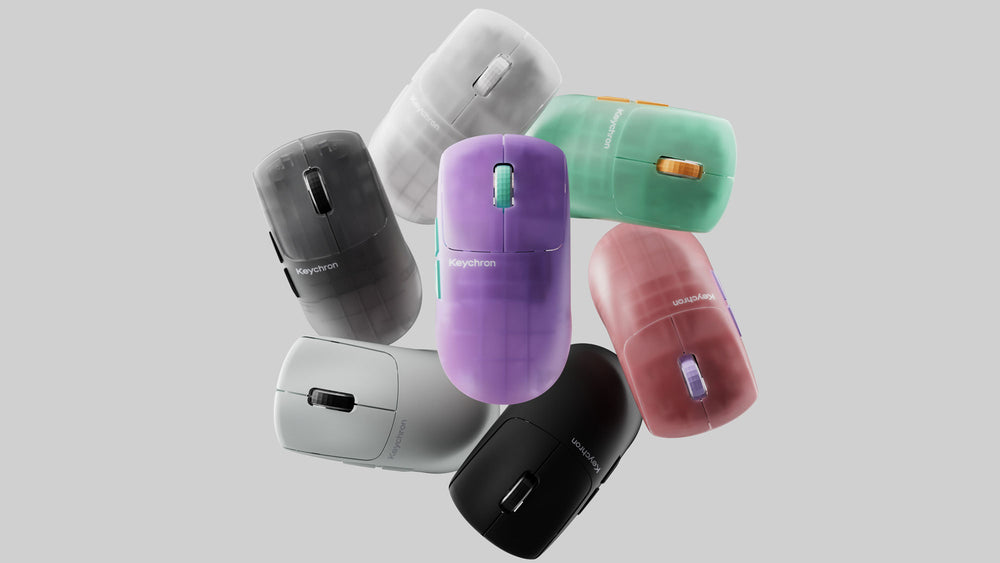
Seven colorways. Black, white, and five frosted translucent finishes (Pink, Mint, Lavender, Ice, Smoke), the frosted options are exclusive to the swappable-battery version. The pastel translucent shells were the most universally praised element of the reveal, which says something about how tired buyers are of black-on-black peripherals.
Performance
Because the G6 HE has not shipped globally, "performance" here is a forecast built from specs, official figures, and the known behavior of the components, not measured results. What the components say: the PAW3955 is a proven flagship-tier sensor (the same class used in premium 2026 releases), and 8K polling with dual Nordic radios is the current ceiling of wireless mouse engineering. If Keychron's 0.301 ms click-latency claim holds up in lab testing, this would sit alongside the fastest wireless mice ever measured, but that is a big if, and it will need an RTINGS-class test to verify.
The genuine open question is the magnetic mode. The most upvoted skeptical comment on the reveal thread put it bluntly: because the hall sensor reads a switch that still has to be physically pressed through its travel, the mouse "will work like a normal mouse with pre-travel until the switch is clicked", meaning the zero-pretravel behavior of a hall-effect keyboard or Logitech's HITS haptics may not translate. The counterargument, also raised in the thread, is that adjustable actuation and rapid trigger are separate from the tactile event: the sensor re-arms on release regardless of where the physical click lands, which is what actually eliminates the reset distance in rapid-trigger logic. Both positions are reasonable, and neither can be settled from a spec sheet. What is known is that the switch does not have haptic feedback, Logitech's HITS implementation synthesizes click feel electronically, while the MagOptic's feel is a fixed physical leaf-spring event, so buyers expecting Superstrike-style adjustable haptics should adjust expectations.
Reddit's overall verdict on the reveal was a shrug-and-wait: "keen to see what the magnetic switches do when they hit reviewers" captured the mood. The clearest community win is the value math, "PixArt 3955, Nordic 54LM20A for this price point is actually insane" was a 12-upvote sentiment that summarized the general reaction to a $90 flagship-spec sheet. The clearest open risks are switch execution, long-term reliability (zero track record), and battery-module longevity, since the swappable pack is the part most likely to wear or become hard to source.
Pros and Cons
Pros:
- Unmatched value in magnetic mice: PAW3955 sensor, 8K wireless polling, and dual Nordic MCUs for $89.99, roughly half the price of the Logitech G Pro X2 Superstrike
- World-first MagOptic switch: optical speed plus magnetic mode with 12-step adjustable actuation and 11-step rapid trigger, features that previously lived on $200+ hall-effect hardware
- True weight tunability: 39 g (wired, no battery) up to 62 g with weight blocks, covering fingertip to palm-grip preferences in one mouse
- Swappable 350 mAh battery with a receiver that doubles as a charging dock, the most sensible answer yet to 8K polling's battery drain
- Open-source ZGM firmware and hardware design files on GitHub, a genuine first for gaming mice, with real enthusiast appeal
- Browser-based Keychron Launcher with on-board storage: no install, no background process
- Seven colorways including five frosted translucent shells; tri-mode connectivity (2.4 GHz / Bluetooth / wired) with up to 340 hours over Bluetooth
Cons:
- Pre-launch product: no independent lab tests, no owner reviews, no reliability data, the entire magnetic-mode experience is unverified
- Magnetic mode's real-world benefit is contested: skeptics argue the physical switch pre-travel means it behaves like a normal mouse with adjustable actuation rather than a true hall-effect experience
- Proprietary battery module with no confirmed third-party availability or long-term durability data
- Medium-large 123.7 mm symmetrical shell with left-only side buttons: small hands and left-handed users are out of luck
- Only ~35 hours at 8K polling, the swappable battery mitigates but does not eliminate the need for spares
- US availability was thin at launch-window press time; early units went through Japan crowdfunding at ¥14,344, 17,930
Who Should Buy This
Buy the G6 HE if you want hall-effect-style adjustable actuation and rapid trigger without paying Superstrike money, if you are tired of charging mid-session and like the idea of a three-second battery swap, or if you want to be early on the open-source mouse movement and are comfortable with the firmware's promise being ahead of its public tooling. It is also simply the most interesting spec-per-dollar mouse of the year for palm and claw grippers with medium or larger hands.
Skip it if you have small hands or use a fingertip grip, the 123.7 mm length and rear hump are real fit risks. Skip it if you are left-handed and need thumb buttons, or if you need more than five buttons. Skip it if you want a haptic-feedback click like the Superstrike, the MagOptic's click feel is physical and fixed, not synthesized. And if your tolerance for first-revision hardware is low, the honest advice is to wait for the first wave of owner reviews and lab tests after the September launch rather than gambling on a crowdfunded early unit. Do not buy one from a reseller at a markup; the $89.99 launch price is the whole point.
Alternatives to Consider
Razer Viper V3 Pro ($119.99), The conventional flagship alternative: 54 g solid shell, Focus Pro 35K sensor, 8K HyperPolling with the dongle in the box, and proven optical Gen-3 switches. It costs $30 more, has no magnetic features, and its flatter hump suits claw over palm, but it is available today, lab-verified, and backed by a real reliability record. Our review scores it 8.9/10.
Logitech G Pro X2 Superstrike ($179.99), The direct magnetic competitor and the product the G6 HE is priced to undercut. The Superstrike's HITS haptics deliver synthesized, adjustable click feel with rapid trigger, the gold standard the MagOptic is chasing, but it costs twice as much, has a front-heavy balance, and lacks Bluetooth. It is the right buy if the haptic click experience is the specific thing you want and price is secondary. Our review scores it 8.6/10.
Keychron G3 8K ($84.99), Keychron's own conventional option at nearly the same price: an 8K wireless mouse with the same Launcher software and a 55 g shell, but plain optical switches and no magnetic mode. If the G6 HE's switch experiment makes you nervous, the G3 delivers 90% of the performance with zero new-tech risk, and it is actually in stock. Our review scores it 8.8/10.
Verdict
The Keychron G6 HE UltraLight is the year's best spec-per-dollar gaming mouse on paper, and the value case is so strong that it survives even the reasonable skepticism the reveal generated. At $89.99 you are getting a 42, 46 gram shell, a PAW3955 sensor, dual-8K wireless, a swappable battery with a dock-charging receiver, seven colorways, and the first open-source firmware in a mouse, features that, taken together, no competitor matches at any price, let alone under $100. The community's value read was near-universal, and the launch coverage matched it.
What keeps this from a 9-plus is that the flagship feature, the MagOptic switch, is exactly where the uncertainty lives. The honest position is that nobody has proven the magnetic mode delivers a meaningfully different feel than a fast optical switch, the click feel is fixed rather than adjustable, and there is zero long-term reliability data for a first-revision product with a proprietary battery module. Buyers who need those answers today should wait for the first wave of reviews; buyers who want the most interesting sub-$100 mouse of 2026 and accept first-revision risk have a genuinely compelling reason to be first in line at the September launch. 8.6/10, Excellent value, unproven execution.
Full Specifications
| Sensor | PixArt PAW3955 (40,000 DPI, 750 IPS, 60 G, glass-compatible) |
|---|---|
| Weight | 42 g fixed / 46 g swappable; 39 g wired without battery; up to 62 g with weight blocks |
| Dimensions | 123.7 x 63 x 41 mm (medium, symmetrical) |
| Switches | Keychron MagOptic dual-mode (optical / magnetic), 100M clicks, 0.6 mm travel, 60 g force |
| Polling rate | 8,000 Hz wireless & wired; 125 Hz Bluetooth |
| MCU | Dual Nordic nRF54LM20A |
| Connectivity | 2.4 GHz + Bluetooth 5.3 + USB-C (tri-mode) |
| Battery | 350 mAh swappable module — ~35 h at 8K, ~340 h Bluetooth |
| Buttons | 5 |
| Extras | Turbo-Link 8K dock receiver (4 macro buttons), open-source ZGM firmware, Keychron Launcher, on-board storage |
| Colors | Black, white, 5 frosted translucent (fixed-battery model black only) |
| Launch | $89.99 global September 2026; Japan early-bird ¥14,344 |
The Verdict: Excellent
The year's best spec-per-dollar gaming mouse on paper: PAW3955, dual-8K, swappable battery with a dock-charging receiver, open-source firmware, and world-first MagOptic switches for $89.99 — half the Superstrike's price. The value case survives the reasonable community skepticism; the unproven magnetic-mode execution and zero reliability track record are the reasons to wait for first-wave reviews. 8.6/10.
— GamepadSquire, August 2026
Related Buying Guide
Buying Guide
Best Gaming Mice 2026: The Complete Guide for Every Budget
The 2026 gaming mouse market explained tier by tier: RTINGS-lab-verified picks from the $25 G203 to the $180 haptic Superstrike, with the Viper V4 Pro, DeathAdder V4 Pro, the $35 VXE R1 Pro budget flagship-killer, and the Chinese mid-range revolution covered in depth.
Buying Guide
Best Lightweight Gaming Mice Under $50 in 2026: The Budget Ultralight Buyer's Guide
The ultralight revolution has reached the budget tier. The best lightweight gaming mice under $50 in 2026 — from the 48g VXE R1 Pro to the ATTACK SHARK X3 — with specs, measured weights, and the QC trade-offs real owners talk about.