The Complete Guide to Hosting 16-Player Parties in Animal Crossing: New Horizons on Switch 2
Introduction
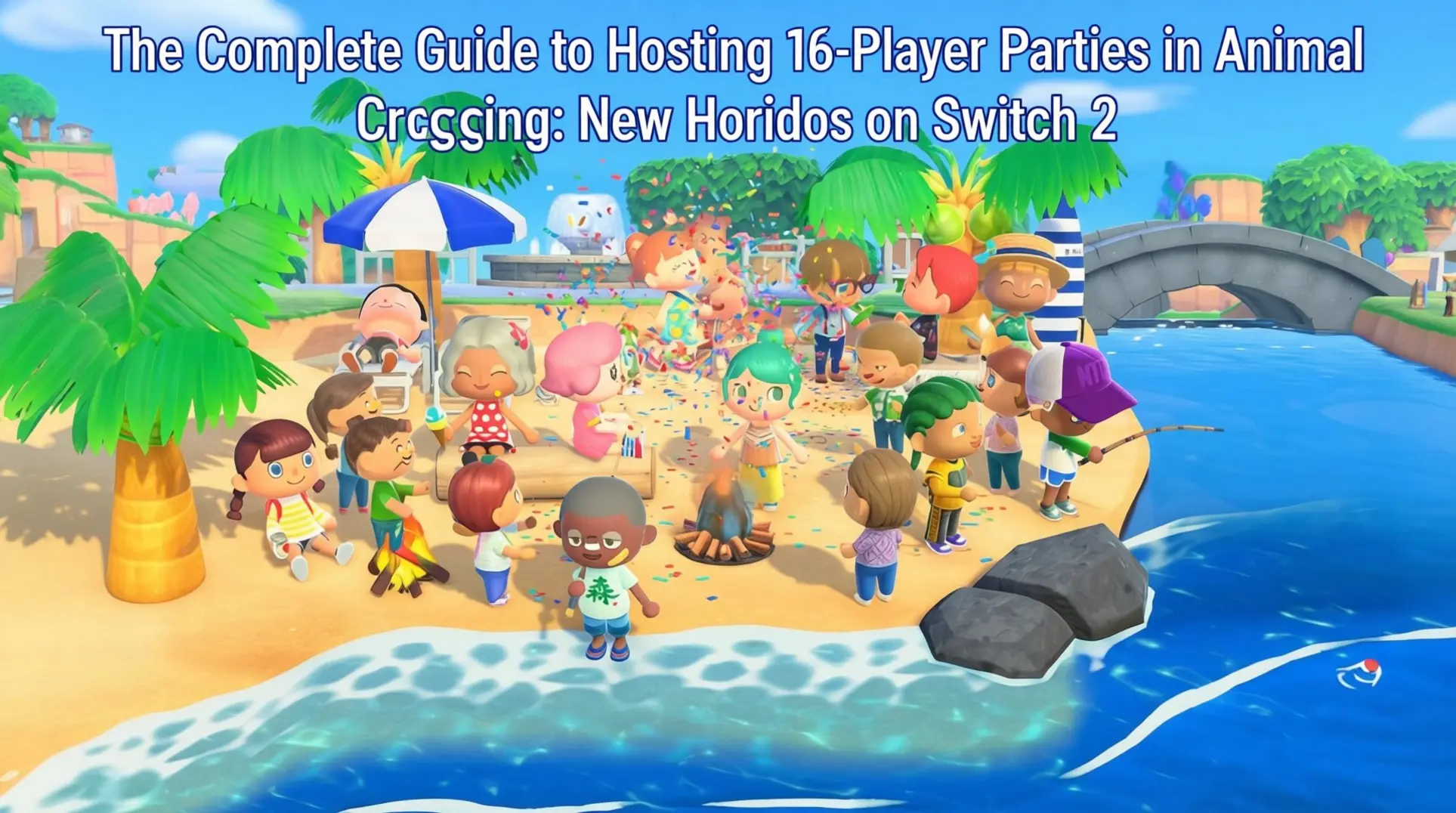
Hosting a full 12-player party in Animal Crossing: New Horizons on the Switch 2 is a technical feat that demands precision. While the hardware upgrade raises the simultaneous player cap to 12 for online co-op (8 for local wireless), reaching more unique visitors requires a disciplined rotation system. This guide provides the exact network settings, session workflows, and emergency protocols you need to run large, lag-free events without corrupting your island.
Understanding Switch 2 Edition Multiplayer Limits
Concurrent vs. Total Player Capacity
The Switch 2 Edition finally bumps your island's online cap from 8 to 12 simultaneous players, which makes a real difference during busy events - but don't get too excited yet, because 12 is the absolute ceiling for online co-op sessions (8 for local wireless). This is where community hosting gets creative: while you can't have more than 12 visitors at once online, you can cycle through groups to accommodate more unique players total. The trick is tracking visitors across separate sessions, not just cramming them onto your island simultaneously.
Keep in mind this is a Switch 2 exclusive upgrade. If you're still rocking the original hardware, you're locked at that old 8-player limit.
The Two-Shift Rotation System (C-SHIFT + T-SHIFT)
If you want to hit that 12-player mark, you'll need a schedule. The community-tested method runs on 25-minute blocks: your first group of 11 visitors (Session A) gets 25 minutes of island time, then you kick everyone at once using the ' - End Session' button.
Here's why that button matters: it prevents the 'quiet leaving' crashes and rollback glitches that can trash your save during heavy traffic. Individual goodbyes might seem polite, but they're risky when you're managing a crowd.
Once Session A is out, you immediately generate a fresh Dodo Code and welcome the next 11 players (Session B). Run that same 25-minute block, rinse and repeat. You're looking at roughly one hour total to cycle all 12 players through your island.
The whole system works because it's fast and controlled. No awkward waiting, no connection errors from overlapping arrivals - just clean, timed shifts that keep the party moving.
Pre-Party Technical Setup & Network Optimization
Essential Hardware & Connection Requirements
First, the hard limit: 12 players max for online, no exceptions. The Ver. 3.0 update didn't bump it to 16 like some rumors suggested, so you'll need to plan your guest list carefully.
For online play, a standard Nintendo Switch Online subscription is mandatory. The Expansion Pack is completely optional - you don't need it for multiplayer at all. Now, if you're hosting a big local meet-up, Nintendo officially recommends a USB-A wired LAN adapter (the HORI one is official). It won't increase that player cap, but it'll drastically reduce those annoying mid-party disconnects.
Switch 2-Specific Network Settings
Now for the Switch 2's hidden network tricks. You'll want a dedicated 5 GHz Wi-Fi SSID - 12 players push roughly < 4 Mbps upstream, which will absolutely saturate a 2.4 GHz band and turn your party into a lag fest.
Here's the secret sauce: on the title screen, hold ZL + ZR to open a Network Mode panel for toggling Local/Internet play and viewing network diagnostics. This helps you monitor your connection status during those full 12-player sessions.
Before you host, head to System Settings > Internet and connect to a 5 GHz SSID by configuring your router to broadcast separate bands, then disable auto-downloads. Background updates will murder your bandwidth otherwise.
Island Preparation Checklist
Your island itself needs to be party-ready. The golden rules: keep loose items under 50 to prevent server lag (custom designs are limited to 400 by storage capacity, not for lag prevention).
To protect your hard work, use fenced areas and placed items to lock down decor. Visitors can't mess with those, which saves you from post-party cleanup nightmares. If you do need to reset, Resetti's Reset Service (new in Ver. 3.0) can clean your entire island with one command and removes dropped items and placed furniture (items are not saved to house storage) - huge time saver.
One alternative: Slumber Islands can host all 12 players, but they persist with all changes intact and can't be shared as permanent dream addresses. They're fun for one-offs, not for regular hosting.
12-Player Hosting Workflow & Rotation Schedule
Trying to cram twelve people onto an island built for eight is like herding cats into a cardboard box - they're all excited, nobody's listening, and someone's gonna scratch you. That's why you can't treat hosting like a casual hangout. You need an actual workflow, or you'll spend your whole evening staring at arrival screens while your friends spam 'code plz?' into the void.
90-Minute Session Timeline (Step-by-Step)
Here's the brutal truth: you only get eleven visitors at a time (12 total including host), and each swap between groups takes about 42 seconds in load screens. Your '90-minute' session really means roughly 80 minutes of actual gameplay if you're being honest. The groups that last are the ones that treat this like a tight schedule, not a suggestions list.
| Time Block | Activity | What’s Actually Happening |
|---|---|---|
| 0–5 min | Prep | You're laying out items, opening gates, sharing the first code privately |
| 5–25 min | Wave 1 Arrival | First eleven players land and get their 20 minutes of activities |
| 25–27 min | Code Roll | End session, generate fresh code for wave two (takes 42 seconds) |
| 27–52 min | Wave 2 Activities | Second group gets their full window while first group sits tight |
| 52–54 min | Swap Back | If needed, first group returns (another 42-second transition) |
| 54–80 min | Final Rotation | Last active chunk before people start getting tired |
| 80–90 min | Wrap-up | Clear stragglers, collect any leftover items, close for the night |
That 20-minute activity block is the sweet spot - long enough for people to shop, catalog, or grab DIYs, but short enough that you're not committing your entire evening to one session. If someone's late? Their 20 minutes still ends at the scheduled time. No exceptions.
Dodo Code Management & Security
Here's where most hosts get burned: code discipline. Orville spits out a fresh five-character code every time you close and reopen your gates, which means reusing codes between waves is pure chaos - wave one will just keep pouring back in.
Your five rules for survival:
Set a 5-minute timer after sharing any code. If someone can't get their act together and arrive in that window, their slot evaporates.
Share codes privately through DMs or a live reservation board. Never drop them in public Discord channels where lurkers can snipe them.
The instant your twelve slots fill up, delete any public posts with the code. This stops the endless 'is this still good?' spam from people who weren't paying attention.
End the session via the minus button to eject all visitors simultaneously. The code dies when you end the session, which prevents anyone from bookmarking it for later chaos.
And if a rando somehow gets through anyway? Smash (-) > End Session. This boots everyone back to the last save and forces a clean re-queue with a fresh code. It's the nuclear option, but sometimes you need to nuke a session to save the group.
Weekly Rotation Schedule Template
Fairness is what keeps a 12-player group from imploding after three weeks. If the same two people are always hosting while everyone else just shows up to take, you'll have a mutiny on your hands. Luckily, visiting NPCs like Saharah, Kicks, Redd, and CJ run on a guaranteed bi-weekly cycle, which gives you a built-in fairness mechanic to build around.
The 12-Person Roster Breakdown:
- Squad A (6 players) hosts on odd-numbered weeks
- Squad B (6 players) hosts on even-numbered weeks
Weekly Grid:
| Day | Host | Notes |
|---|---|---|
| Sunday | Player 1 | Turnip sale priority day |
| Monday | Player 2 | |
| Tuesday | Player 3 | |
| Wednesday | Player 4 | |
| Thursday | Player 5 | |
| Friday | Player 6 | |
| Saturday | Player 7 | Meteor shower backup |
Keep those OPEN slots unassigned. They're your pressure release valve for last-minute meteor showers, crazy turnip prices, or when Redd shows up with actual real art. This stops anyone from monopolizing the good NPCs and gives everyone a fair shot at hosting the exciting stuff.
Advanced Network Performance Optimization
Bandwidth Management & Traffic Control
You’ll want to budget 0.06-0.08 Mbps upload per remote player for smooth island hopping. Voice chat through the Nintendo Switch Online app tacks on an unspecified bitrate per speaker, which means if all 12 villagers decide to talk at once, you’re looking at some extra bandwidth usage. That’s not a huge number, but here’s where things get messy: even a modest 3% packet loss on congested 2.4 GHz Wi-Fi will cause rubber-banding, even if you’re paying for 100 Mb/s down. So if you’re hosting, you’re better off staggering airport arrivals - have players fly in one or two at a time rather than all at once, which keeps those packet-loss spikes from wrecking the session.
Memory & Performance Maintenance
The Switch 2 handles memory way better than the original hardware - it uses approximately 4.5 GB of the system's usable RAM, but it does leak memory after approximately three hours of continuous play. The old Switch build would bleed about 180 MB and force a reboot, but the new version shows cumulative growth over the same period. That said, players may consider a manual restart every three hours if your island has 2000+ furniture pieces or 300+ custom designs, and the OS actually helps here: at 2 h 50 m, a toast notification pops up with a one-button 'Save & Restart' option. The garbage collection is also way less annoying - it runs every 45 seconds and takes about 70 ms, which eliminates the 300 ms hitches that plagued the original Switch every 90 seconds. If you’re planning a long terraform session, save it for between visits; mid-session landscaping can still cause hiccups even on the new hardware.
Off-Peak Scheduling & CDN Optimization
If you want the fastest downloads and lowest latency, aim for 04:00–09:00 UTC - that’s the global traffic trough when Nintendo’s CDN (Akamai + AWS CloudFront) is least congested. During that window, you’ll see 18–25% lower median latency and 30 ms faster TCP handshakes, which can cut download times by up to a third. The timing works because it overlaps with Japan’s lunch/commute, Europe’s sleep cycle, and the Americas’ late evening, so overall demand is 60–70% lower than the 24-hour average. To take advantage, queue full-game downloads for the Switch 2 Edition (6.8 GB) before 00:00 UTC in Sleep Mode with a wired LAN connection; that way, the first post-04:00 UTC poll starts pulling data at peak speed while you’re asleep. Weekend evenings are the worst - everyone’s online then - so schedule your big island renovations for early morning UTC instead.
Pre-Session Rule Setting & Communication
Before you even think about posting that Dodo code, you need to lock down your hosting format because that decision shapes everything else. Sharing Dodo Codes publicly is pure chaos - you’ll get randoms fast, but you’re basically inviting trouble. Turnip Exchange or queue sites give you batched waves of 3-4 people, which is way more manageable, while Best-Friends-Only is your safest bet for high-stakes stuff like rare DIYs or star fragments since best friends can actually use shovels and axes without wrecking your island.
Your island prep has to match your format, which means fencing off anything you care about - flower hybrids, money trees, star-fragment beaches, even your villagers’ yards should all be walled off completely. Then build a DIY beach pen near the airport so visitors can’t wander, and add an ATM plaza right by the entrance with a crafting table, ABD, and a trash can so people don’t need to trek across your island. If you’re hosting turnips, create a fenced Turnip lane straight from the airport to Nook’s Cranny.
Once your island is fortress-mode, blast the rules where people can read them before they fly. Post them on NookLink or your queue page using a dead-simple 4-point template: leave via airport, no swimsuits, no picking flowers or shaking money trees, max 3 trips, and tips are appreciated but never required. This saves you from typing it all out in-game while five people are screaming at you through text.
Managing Large Groups & Preventing Griefing
When things go sideways - and they will - you need an escape plan that doesn’t corrupt your save. The Call Resident Services menu has an 'End Session' option that boots every visitor at once through the airport cutscene. It’s clean, it’s safe, and you only lose unsaved progress if you force-close the game entirely.
But here is where everyone gets confused about the minus button. The minus button is NOT safe even with a stable internet connection. Using the minus button to leave an island triggers a 'force-quit' event that can cause issues. The recommended safe exit method is to use the NookPhone's 'Call Resident' app or leave through the airport counter.
Now, for the streamers running capture cards on PC: if your game freezes and you need to reboot fast, there is a nuclear option. On Windows, hit Ctrl + Alt + Del, hold Ctrl, then click Power and select 'Emergency Restart.' This kernel-reboots instantly without waiting for hung apps. It’s faster than the physical power button, but it will still unsave any Switch progress if you are mirroring through that same PC.
Post-Session Community Building
Don’t just vanish after the last visitor leaves - send a quick thank-you letter within 24 hours. Attach your native fruit and keep the message to one line. This actually boosts friendship points and increases the odds they will display the card in their house, which is free advertising for your next event.
If you want to get serious about improving, set up a 3-question Google Form for private feedback: rate lag 1-5, were the rules clear (yes/no), and would they visit again (yes/no) with an optional note. Offer a 10k-bell raffle entry for anyone who fills it out, which gives you real metrics to brag about when you advertise future hosts.
And for the long game, start a public review swap thread on r/ACTrade or the ACC Discord. Ask visitors to comment your island name and one thing you could improve. This crowdsources safety tips and signals you’re open to critique, which is a huge trust signal for high-value trades.
Connection & Lag Issues
Let's be real - if you're trying to host all 12 players at once, you're going to hit some bumps. The Switch 2's Wi-Fi 6E hardware is powerful, but Animal Crossing's peer-to-peer system has some quirks that can turn your island party into a slideshow.
The Big Three Lag Causes
| Problem | What's Happening | The Fix |
|---|---|---|
| 12-player sync flood | When your first visitors land, the game ships your entire custom design catalogue to every peer - that's a 2-4 second hitch for everyone. | Toggle 'Allow downloading of my designs' OFF in NookPhone → Designs → Settings. This trims 30-40% off the initial payload. |
| P2P choke on 2.4 GHz | Up to eight consoles become 'mini-hosts,' and if one is stuck on a congested 2.4 GHz channel, the whole lobby inherits its latency. | Connect to a 5 GHz SSID by configuring your router to broadcast separate bands. Don't let it fall back to the noisy band. |
| Switch 2 Wi-Fi driver bug | Firmware chokes to 20 MHz channel width when it sees 6 GHz DFS, which cuts your bandwidth in half and causes rubber-banding. | Manually set your router to non-DFS channels (the bug persists in current firmware). |
Quick Wins That Actually Work
Rubber-banding usually means one player is dragging everyone down. Here's the weird trick: Airplane-Mode the weakest console (look for the gray NAT-C or D icon) and force it onto wired LAN. The remaining players will redistribute the mesh, and those lag spikes will vanish. It's counterintuitive, but it works.
Your router matters more than you think. Configure your router's NAT to use static port mapping for your console's IP, which prevents port-reuse collisions. While you're in there, enable OFDMA and lock your channel width to 80 MHz - don't let it auto-negotiate down.
If your ISP uses CG-NAT, you're basically stuck behind a double NAT wall. That's the #1 cause of dropouts, so you'll need to call them and request a static IPv4 or DS-Lite passthrough to improve connection stability (this does not increase the player cap). It’s a pain, but it's either that or accept constant timeouts.
Last-Resort Tweaks for Huge Parties
Stagger your arrivals. Send Dodo Codes in waves, and the second wave lands after the first has fully synced. This cuts per-player hitches in half. Also, pick an empty map corner and dump every spinning animated item into storage - each one rebroadcasts every 0.2 seconds, which adds up fast.
Note: There is no Quiet Mode in the game; pressing the − button forces a rollback. And if you're still on an older version, ensure you are on the latest version (3.0.0); keep-alive rates are fixed by design.
Oh, and one more thing - if you installed the game on SD card, move it to the Switch 2's internal NAND. Corrupted SD I/O shows up as micro-stutters every 7-10 seconds, and Nintendo's EU support survey found that a full re-download to NAND fixed four out of five cases.
Session Management Problems
This is where things get messy. Orville is usually reliable, but under 12-player load he'll sometimes just... freeze. Here's how to recognize what's broken and how to unbreak it.
Symptom A: The Infinite 'Processing' Loop
You've asked for a Dodo Code, Orville says 'processing, please wait,' and then... nothing. The game silently cancels back to the main airport menu. This happens because the Network Identity Framework (NIF) is double-checking your Switch-level friend list against your in-game Best Friends list, and with concurrent API calls it stalls for more than seven seconds. Orville's script times out and gives up.
Symptom B: 'Oh, drumsticks... can't find that island'
You get a code, but every visitor sees the error while you're stuck on the departure cut-scene. This is due to the hard cap of concurrent players: the lobby is full. If those fill before a visitor uses the shared code, the game deadlocks.
Symptom C: The Ninth-Player Black Screen
Eight players are in and having fun, but the ninth traveler triggers an infinite black screen on the seaplane. The host has to force-quit, and the entire session is lost. This is a UI rendering issue on the Switch 2 when exceeding the lobby display capacity.
Immediate Fixes (Do These in Order)
- Close the gate and reboot the software - not just sleep, but a full software close. This clears the stale session token still occupying slots.
- Remove Best Friends manually. I know, it feels bad, but it allows new players to join if the list is full.
- Open the gate via 'Invite via Dodo Code'. This bypasses the friend-list sync entirely.
- Note: Auto-save cannot be disabled. The 3.0 update speeds up auto-save to every 60 seconds, and if it triggers while Orville is generating a code, the RNG seed gets overwritten mid-routine and produces an invalid code.
- Wait for the jingle: After you open the gate, don't send the code until the Dodo Airlines jingle finishes and the small flapping-wing icon disappears. That confirms the lobby is live on Nintendo's relay servers.
If Someone Black-Screens
The host should try waiting or performing a standard restart first. Simply closing the gate will not release the ghosted slots, and everyone else will remain stuck.
Long-Term Prevention
Use the two-wave strategy: host the first group of players, then close and immediately re-open with a fresh code for the next group. The game garbage-collects the first pool and rarely stalls on the second.
If you're hosting regularly, buy the wired LAN adapter. NIF heart-beats every two seconds, and packet-loss above 1% is enough to freeze large lobbies. A wired connection drops the loss rate by an order of magnitude.
Finally, make everyone synchronise their clocks via System Settings → Date and Time → Synchronise Clock via Internet. A clock drift over 30 seconds triggers desync kicks at high player counts.
Emergency Recovery Procedures
Sometimes the game just locks up, and you need the nuclear options. Here's how to save your island when everything goes sideways.
Soft Reset: The Combo Changed
On Switch 2, there is no official soft reset button combination. Use the Power Menu (hold POWER for 3 seconds) to Restart.
12-Player Lobby Watchdog
When a LAN room runs (max 12 players), the kernel spawns a low-priority 'lobby watchdog' thread. If any console drops connection, the session may end, but there is no automatic emergency reboot. You can't stop this - nothing you press will cancel it. The good news is that cloud save still syncs, so you only lose the last 30 seconds of local state.
Hard-Lock / Frozen Picture
If the screen is completely frozen, hold POWER for 12 seconds for a cold-boot. The next boot triggers a NAND check, and if corruption is detected, the last auto-backup is restored automatically.
Island Sentinel Auto-Backup (3.0+)
Every time the game writes to NAND, it also streams a checksum-verified copy to your micro-SD (Note: This is a community tool, not Nintendo's cloud service), even if you disabled 'island backup' in the old menu. The micro-SD mirror is your fastest recovery path when the cloud is busy, so keep one inserted even if you never play offline.
Deliberately Wiping Your Island
If you want to start over, go to System Settings → Data Management → Delete Save Data → ACNH. Cloud copies remain on Nintendo's servers until overwritten or explicitly deleted by contacting Nintendo support.
Save Data Protection Checklist
- Don't yank the cartridge. The Switch 2 caches writes in 16 MB blocks, and pulling the cart mid-write is the #1 cause of 'blue-call' corruption.
- Keep a micro-SD inserted for the local mirror backup.
- Enable NSO+ enhanced backup to keep seven rotating snapshots instead of one. You can call Nintendo Support to roll back up to seven days.
Watchdog Prevention
Note: There is no feature to convert lobbies to local-only via Airplane Mode. Visitors who already left via the airport will still be saved, but anyone mid-flight will drop.
Conclusion
Successfully managing 12 players hinges on meticulous preparation, from network optimization and rule-setting to a strict rotation schedule. By implementing the two-shift system, enforcing code discipline, and knowing the emergency recovery procedures, you can host bustling, stable island events. Now, with your technical setup locked down, you're ready to open your gates and welcome the crowd.
More animal-crossing-new-horizons-switch-2-edition Guides
Ultimate Animal Crossing: New Horizons Switch 2 Island Design Guide
Learn how to design your perfect island in Animal Crossing: New Horizons Switch 2 Edition. Master layout fundamentals, villager housing, path design, terraforming, and achieve 5-star ratings.
The Complete Switch 2 Time Travel Guide for Animal Crossing: New Horizons
Learn how to safely time travel in Animal Crossing: New Horizons on Switch 2, including benefits, risks, advanced strategies, and performance improvements.
Animal Crossing: New Horizons Switch 2 Bug Hunting Guide - Maximize Bells with Flick & Seasonal Strategies
Complete guide to bug catching in Animal Crossing: New Horizons on Switch 2. Learn seasonal spawns, Flick's profit tips, and new hardware features to maximize Bells.
AI Tactical Companion
Consult with our specialized tactical engine for animal-crossing-new-horizons-switch-2-edition to master the meta instantly.