RimWorld Colony Psychology: Complete Mood & Recreation Guide
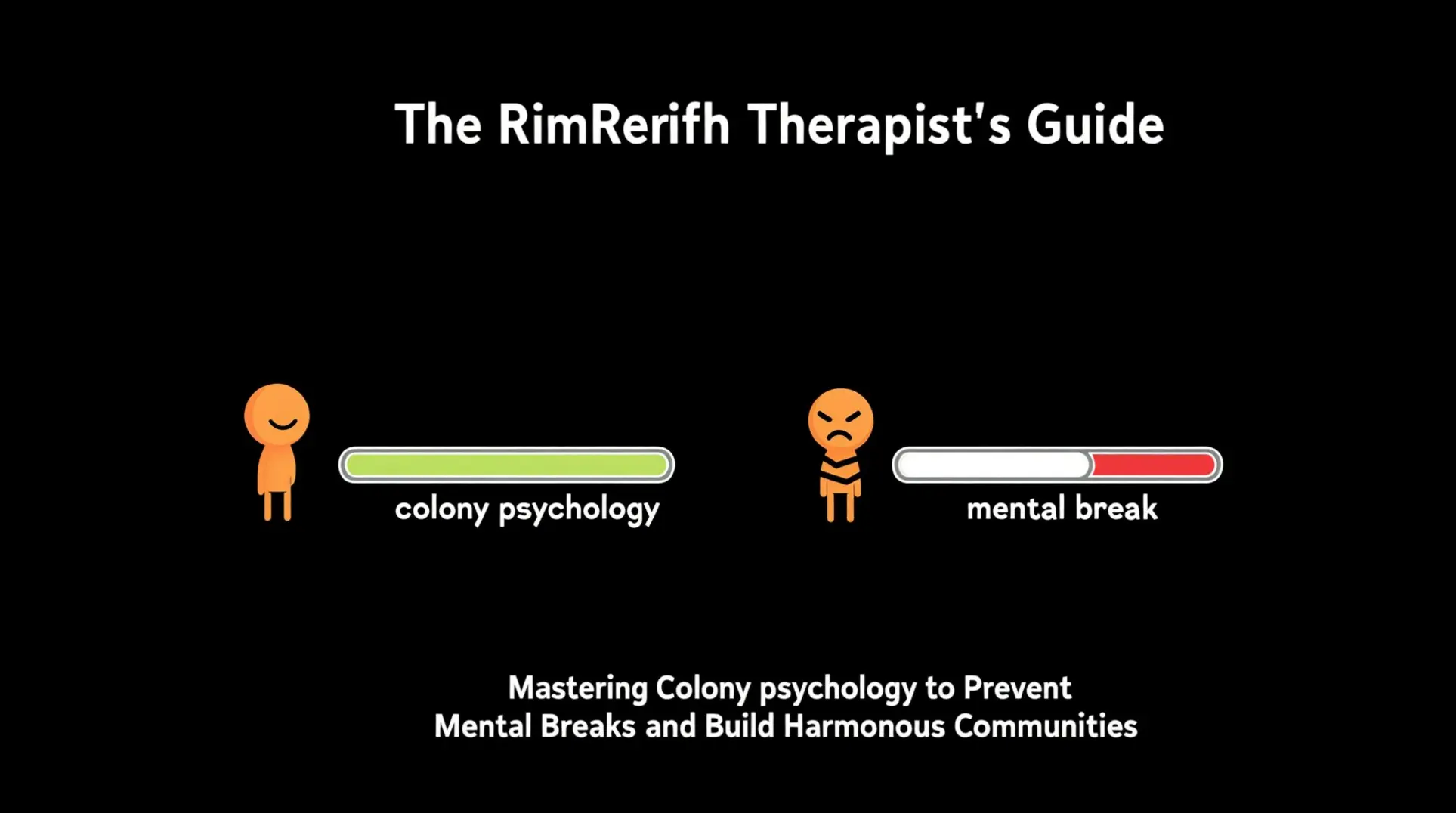
RimWorld's psychological systems form a complex web where mood, recreation, beauty, and social elements constantly interact. Mastering these mechanics is essential for colony survival and prosperity.
Understanding the Core Mood System
Mood in RimWorld operates on a 0-100% scale, represented by a blue bar in the Needs tab. This scale ranges from 0% (despair) to 100% (euphoria).
Mental Break Threshold (MBT): This is the specific mood level below which a colonist will suffer a mental break. The threshold varies by colonist based on traits, difficulty settings, and recent experiences.
Mental Break Risk Levels
Mental breaks occur when a colonist's mood drops below their Mental Break Threshold. The severity depends on how far mood falls below the MBT:
- Minor Break Risk: Occurs when mood is just below the MBT
- Major Break Risk: Triggered when mood is significantly below the MBT
- Extreme Break Risk: Occurs when mood is far below the MBT
Low mood below 40% triggers varying levels of break risk, escalating from minor disruptions to catastrophic mental breaks. High mood above 80% can induce inspirations, providing positive benefits to the colony.
Trait-Based Mood Variations
Traits significantly impact colonist mood baselines and responses. These innate characteristics can make or break your colony's psychological stability:
- Neurotic: Reduces mood by 15%, creating significant management challenges
- Optimist: Increases mood by 10%, providing a natural buffer against mental breaks
- Psychopaths: Ignore baby crying penalties that affect other colonists
Work Passions: These provide ongoing mood boosts of +15% when actively working in a passionate field. This incentivizes strategic work allocation based on colonist preferences.
External Factors and Difficulty Modulation
Difficulty settings directly modulate mood mechanics. Lower difficulties raise the Mental Break Threshold, making colonists more resilient, while higher difficulties lower it and increase break frequency.
Environmental factors significantly impact mood through several key elements:
- Room quality (beauty and ugliness)
- Recreation scheduling
- Comfort items like fire, tables, and art
Behavioral Effects and Colony Performance
Colonists with high mood work faster, socialize better, and contribute positively to colony morale. This creates a beneficial cycle that strengthens the entire colony. Conversely, colonists with low mood may become unproductive, hostile, or even violent, potentially triggering cascading failures that threaten colony stability.
Effective mood management requires proactive scheduling and environmental design. Scheduling daily recreation time (such as 2 hours after waking) is critical for mood maintenance and preventing mental breaks.
Mood Emitters: Devices like Soothing Pulsers and Mood Harmonizers can provide temporary mood boosts. These are affected by psychic sensitivity traits.
The Psychology of Recreation and Entertainment
Understanding Recreation Mechanics and Tolerance
The tolerance system requires colonists to engage in 2-4 hours of recreation per day. As colony wealth increases and recreation quality improves, this tolerance threshold decreases.
Tolerance System: A mechanic requiring colonists to engage in recreation daily, with requirements scaling based on colony wealth and activity quality.
Recreation quality is measured by impressiveness. Higher quality recreation provides better mood restoration and longer-lasting effects per hour of activity.
Recreation Quality: A measure of activity effectiveness based on impressiveness, determining mood restoration power and duration.
Recreation tolerance decreases with higher colony wealth. Wealthy colonies must provide higher quality recreation to achieve the same mood benefits.
Colonist Preferences and Activity Diversity
Each colonist's recreation preferences are randomly assigned and permanent. This immutability requires building diverse recreation options to satisfy your entire colony. These recreation preferences align with colonist personalities:
- Intellectual colonists: Prefer chess and reading
- Social colonists: Enjoy group activities
- Physical colonists: Prefer sports and manual labor
The recreation system includes over 20 different activities:
Intellectual Activities:
- Chess - Superior mood restoration for intellectual colonists
- Reading - Particularly effective for neurotic colonists
Physical Activities:
- Horseshoes - Moderate mood restoration
- Billiards - Moderate mood restoration with social benefits
Social Activities:
- Television viewing
- Poker games
- Group recreation activities that strengthen relationships
Reading and chess provide intellectual colonists with superior mood restoration compared to physical activities. Physical recreation activities like horseshoes and billiards provide moderate mood restoration but require colonists to have appropriate physical capabilities.
Social recreation activities provide dual benefits by restoring mood while strengthening relationships between participants.
Designing Impressive Recreation Spaces
Impressive rooms deliver crucial mood management bonuses:
- Dining rooms: Provide +8 mood
- Recreation rooms: Offer +6 mood
Impressive Rooms: Beautifully designed spaces that provide significant mood bonuses, with dining rooms granting +8 and recreation rooms +6.
Recreation rooms should be designed with high beauty ratings through sculptures, good lighting, and quality furniture. These elements maximize mood restoration efficiency.
Beauty as Environmental Psychology
Beauty in RimWorld is defined as 'how enjoyable an object is to look at' and operates as a measurable environmental variable that directly influences colonists' mental states through a beauty meter system. When a colonist's beauty meter is satisfied, they gain a positive beauty mood bonus, while a lack of beauty triggers a 'beauty need' penalty that reduces mood by several points per day.
Understanding the Beauty Meter System
Beauty Meter: This system tracks environmental satisfaction and directly impacts colonist mood. A filled meter grants positive mood bonuses, while an empty meter imposes daily penalties.
All beauty modifiers are cumulative. A colonist with the 'Pretty' trait (+1) and aesthetic nose (+1) has a total beauty of +2, which can be further boosted by environmental factors. Disfigurement adds a −15 opinion penalty to any colonist that sees the disfigured colonist and nullifies the effect of positive beauty on that pawn.
Sculptures: The Ultimate Beauty-to-Wealth Investment
A single small marble sculpture of 'good' quality contributes 137 environmental beauty to its tile, making sculptures the most efficient beauty source in the game.
Beauty Formula for Sculptures: (Base × Material Modifier + Material Offset) × Quality Multiplier
- Marble has a 1.35 modifier and +1 offset
- A legendary sculpture surrounded by eight other masterwork or legendary sculptures can push meditation focus strength up to 44%
Sculptures provide roughly three times the beauty per wealth unit compared to high-end flooring, achieving a superior beauty-to-wealth ratio of 0.685 versus 0.2 for fine stone flooring.
Practical Beautification Strategies
The optimal beautification strategy combines smoothed floors for broad coverage with high-quality sculptures for dramatic boosts, achieving maximum beauty-to-wealth efficiency:
- Smoothed stone floor: Provides +2 beauty per tile with no extra wealth cost
- Fine stone flooring (marble): Provides +4 beauty per tile but adds modest wealth
- Daylilies in flower pots: Provide +8 beauty per pot
- Roses: Provide +6 beauty per pot, making them inexpensive and renewable beauty sources
- Ideology flooring: Provides an extra mood buff on top of its beauty value, making it worthwhile for colonies with the Ideology expansion despite higher costs
Expectations System and Wealth Management
Understanding Expectations Tiers and Wealth Thresholds
The expectations system directly ties colonist mood to your colony's total wealth. This creates a dynamic where growing prosperity changes how colonists perceive their living conditions.
Colony Wealth: The total market value of all items, buildings, and colonists in your settlement. You can view this metric in the History tab under the Statistics section.
The system operates through specific wealth tiers:
Extremely Low Expectations: Under 15,000 wealth (+30 mood bonus)
- New colonists typically experience this on Day 1
Low Expectations: 15,000 to approximately 50,000 wealth (+18 mood bonus)
- Represents a two-level gap from Extremely Low Expectations
Moderate Expectations: Mid-range wealth levels (+12 mood bonus)
- Serves as a transitional stage between low and high expectations
High Expectations: Higher wealth levels (-4 mood debuff)
- Marks the point where colonists begin expecting better living conditions
Sky-High Expectations: 308,000 colony wealth (0 mood effect)
- Represents complete removal of the early-game support system
Special role colonists face additional challenges. Nobles and Ideology role holders have expectations two levels higher than common colonists. When common colonists reach Sky-High Expectations, these special roles enter Supreme Expectations with a -22 mood penalty on losing is fun difficulty.
The Philosophy Behind the System
The expectations system functions as a strategic 'crutch' for struggling colonies. It provides substantial mood bonuses that gradually disappear as your wealth increases.
Design Purpose: The system serves three key functions:
- Offers early game support through generous mood bonuses
- Facilitates mid-game transition by encouraging investment in actual mood-improving mechanics
- Creates late game challenge requiring mastery of all colony management aspects
This design philosophy encourages investment in actual mood-improving mechanics. As automatic mood bonuses gradually disappear with increasing wealth, players must develop genuine colony improvements.
Wealth Management Strategies
Effective wealth management becomes crucial as expectations tighten. Two primary approaches exist for handling this challenge:
Wealth Control: Involves purposefully reducing total wealth to maintain lower expectation tiers.
Strategic Distribution: Focuses on managing how wealth is accumulated and displayed throughout your colony.
A key strategy involves prioritizing beauty improvements over individual comfort items. Sculptures placed in high-traffic areas provide better mood benefits compared to expensive personal bedrooms.
Social Dynamics and Relationship Management
Monitoring Social Dynamics Through the Social Tab
The Social tab shows each colonist's opinions of other colonists and their relatives. Only humans can have opinions of each other, as animals and androids don't participate in the social system.
Social Ecosystem: Colonist opinions evolve dynamically based on interactions, shared experiences, and ideological differences. This creates a fluid social ecosystem that changes throughout gameplay.
Psyche System: Every colonist has their own attitude and personality as part of the psyche system. This operates entirely separately from traditional traits, creating unique individual behaviors.
Social Opinions: Colonists engage in conversations about multiple topics to form opinions on various subjects. These interactions actively shape the social dynamics of the colony.
How Relationships Impact Mood and Colony Stability
Mood Feedback Loop: Mood and social interactions create a feedback loop where positive social interactions improve mood while poor relationships degrade it. This makes social management essential for colony stability.
Mood Consequences: Prisoners with high mood are easier to recruit and less likely to break out or go berserk. Conversely, colonists with low mood for extended periods can suffer mental breaks or attempt to leave the colony.
Social Satisfaction: Socially satisfied colonists are more productive, creative, and resilient against mental breaks. Social isolation or conflict can quickly destabilize even well-resourced colonies.
Relationship Effects:
- Positive relationships: Lead to collaborative behaviors, improved mood through social support, and enhanced work efficiency
- Negative relationships: Result in conflicts and reduced cooperation
Tangible Benefits: Social relationships provide mood boosts that directly impact colonist productivity and mental stability. This creates tangible gameplay benefits beyond roleplaying value.
Conflict Cascades: Conflicts between colonists create mood penalties that can cascade into serious problems, including violence and colony destabilization if left unmanaged.
Proactive Social Management Strategies
Romantic Relationships: Romantic relationships in RimWorld involve multiple stages from initial attraction to falling in love, marriage, and potentially heartbreak. These are designed to feel natural and emergent.
Ideology Impact: Ideological differences can create social tension between colonists who hold conflicting beliefs. Shared ideologies can strengthen bonds and improve relationships.
Practical Management Techniques:
- Schedule consistent shared meals to help colonists develop favorable opinions of each other
- Organize group activities as a way to strengthen social bonds
- Be mindful that colonists who witness failures may form negative opinions
Integrated Management: Successful colony management requires attention to social dynamics alongside traditional resource management. Social satisfaction directly impacts overall colony resilience and productivity.
Mental Breaks: Types and Crisis Intervention
Understanding Mental Break Thresholds
Mental Break Threshold: The critical point at which a colonist's mood triggers a mental break. Severity is determined by how far below this threshold the mood has fallen, with greater gaps resulting in more severe break types.
Mental breaks are categorized into three escalating threat levels. Minor breaks cause temporary disruption, major breaks threaten colony stability, and extreme breaks can result in permanent loss.
Minor Mental Breaks
Minor mental breaks include manageable behaviors that rarely endanger colony survival:
Wandering: Colonists leave their work area and wander the map for several hours, potentially exposing themselves to dangers or getting lost.
Social Fighting: Colonists engage in fistfights that cause minor injuries but rarely result in death, making them less dangerous than violent mental breaks.
Binging: Colonists consume excessive amounts of alcohol, drugs, or psychite, which can lead to addiction, overdose, or permanent health damage.
Major Mental Breaks
Major mental breaks pose significant threats to colony stability and require immediate attention:
Berserk: Colonists launch violent attacks on other colonists.
Murderous Rage: Affected colonists will actively seek and attack specific targets with lethal intent.
Psychotic Break: Random violence against both colonists and structures.
Fire Starting: Deliberate arson that can destroy entire colonies if not quickly contained, as the colonist ignites multiple fires across the base.
Sabotage: Colonists destroy important equipment, buildings, or valuable items, potentially crippling colony operations if critical infrastructure is targeted.
Extreme Mental Breaks
Extreme mental breaks represent the most severe mood crises:
Give Up: Colonists lie down and refuse to move, becoming completely unresponsive and may die from exposure, starvation, or attacks if not rescued.
Catatonic: Colonists become completely unresponsive to player commands, requiring extended care and monitoring until they recover naturally.
Jail Break: Attempting to free prisoners, which can disrupt your entire prison security system.
Caravan-Specific Mental Breaks
Caravan mental breaks are unique events where colonists may abandon the caravan group. This requires immediate rescue decisions that can result in permanent loss or death if not managed properly.
Crisis Response Protocols
Immediate intervention strategies can prevent disaster when mental breaks occur:
Arrest and Release Strategy: Manually arrest a breaking colonist, wait for their mood to recover in captivity, then release them back into the colony.
Other Immediate Interventions:
- Assigning well-liked colonists to provide social support
- Temporarily reducing workload to allow mood recovery
- Using recreation therapy during mental break recovery to help restore mood faster
The Arrest vs. Catharsis Trade-off
The Catharsis Mood Buff provides a significant mood boost after experiencing a mental break. This incentivizes some players to let breaks happen naturally rather than preventing them entirely.
The arrest and release strategy eliminates this catharsis buff while preventing property damage and violence. This choice represents a fundamental colony management philosophy trade-off between short-term safety and long-term mood optimization.
Prevention Through Colony Management
Proactive management prevents most mental breaks before they start:
Workload Distribution Monitoring: Helps prevent mental breaks by ensuring no colonists are consistently overworked while others have excessive leisure time.
Recreation Therapy: During recovery can help restore mood faster, with impressive recreation rooms providing significant mood restoration benefits.
Mental breaks can be triggered by specific events like witnessing death, experiencing pain, or being overworked, with some colonists being more susceptible based on their traits.
Advanced Psychology: Individual Traits and Differences
Understanding Trait-Based Mood Variations
Each colonist has unique personality affecting mood responses. Some traits provide natural mood benefits while others create challenges.
Neurotic: This trait reduces mood by 15%, creating significant management challenges.
Optimist: This trait increases mood by 10%, providing a natural buffer against mental breaks.
Some colonists are more susceptible to mental breaks based on their traits. This makes trait identification crucial for colony management.
Work Passions: These provide ongoing mood boosts (+15% when actively working in a passionate field) and are crucial for maintaining positive mental states.
The Psyche System vs Traditional Traits
The psyche system operates entirely separately from traditional traits, creating unique individual behaviors. This dual-layer system means colonists have both static traits and dynamic psychological profiles.
Every colonist has their own attitude and personality as part of the psyche system. These psychological factors interact with traits to produce complex behavioral patterns.
Strategic Trait Management
Psychopaths: Ignore baby crying (-4 mood) penalty that affects other colonists. They also handle corpse disposal without mood penalties, making them ideal for unpleasant tasks.
- Assign psychopaths to baby care and corpse handling duties
- Use their immunity to social penalties for colony efficiency
Fire-weakness traits: Require special role assignments to prevent mood penalties from fire exposure. Sensitive colonists need high-beauty environments to avoid negative mood effects.
- Keep fire-weak colonists away from incendiary weapons and firefighting roles
- Designate high-beauty areas for sensitive colonists to work and live
Workaholics: Require enforced rest periods to prevent burnout and mental breaks. Individual recreation preferences are randomly assigned to colonists and cannot be changed.
- Schedule mandatory downtime for workaholic colonists
- Provide recreation types that match each colonist's preferences
Assign roles/environments accounting for psychological profiles. This holistic approach ensures each colonist operates in conditions suited to their specific trait and psyche combination.
Environmental Psychology and Colony Design
Environmental Impact on Mental Health
Environmental factors significantly impact mood through room quality (beauty/ugliness), recreation scheduling, and comfort items like fire, tables, and art.
Room placement, traffic patterns, and architectural design affect mental states. Natural lighting, ventilation, and spatial relationships influence well-being.
Spatial Relationships: The arrangement of rooms and pathways directly affects colonist mood and behavior.
Room Placement and Architectural Strategy
Strategic room quality prioritization maximizes mood benefits. Focus on high-traffic areas like dining halls and bedrooms for the greatest impact.
Larger, well-designed rooms provide stronger mood bonuses than cramped spaces. This makes spatial planning crucial for colony mental health.
- Prioritize dining halls and bedrooms for quality improvements
- Design spacious rooms rather than cramped quarters
- Consider traffic flow when placing important rooms
Optimal Beautification and Wealth Balance
Balance beauty improvements against wealth-induced raid risks. Impressive dining rooms provide +8 mood bonus, while recreation rooms provide +6.
Beauty-to-Wealth Ratio: This measures how much mood benefit you gain relative to the wealth increase that raises raid difficulty.
Sculptures provide superior beauty-to-wealth ratio compared to expensive flooring. The optimal beautification strategy combines smoothed floors for broad coverage with high-quality sculptures for dramatic boosts.
Recreation rooms should be designed with high beauty ratings through sculptures, good lighting, and quality furniture to maximize mood restoration efficiency.
- Use smoothed floors for cost-effective beauty (+2 per tile, no wealth cost)
- Place sculptures for high-impact beauty with good wealth efficiency
- Add daylilies in pots (+8 beauty) over roses (+6 beauty) for maximum effect
- Design recreation rooms with sculptures, good lighting, and quality furniture
The Paradox of Success: Why Mental Breaks Increase with Colony Growth
The Counterintuitive Correlation Between Success and Stability
Success in RimWorld creates unexpected psychological burdens. Larger colonies develop complex social dynamics that increase conflict chances, while higher expectations add stressors as wealth grows.
Colony Wealth: The total market value of all items, buildings, and colonists in your settlement. This metric directly triggers increasingly harsh expectation thresholds.
The expectations system initially acts as a crutch for poor colonies by providing mood bonuses. These benefits gradually disappear as wealth increases, removing the safety net just as new challenges emerge.
Social isolation or conflict can destabilize even well-resourced colonies. Conflicts between colonists create mood penalties that cascade into serious problems, making management critical.
- Larger colonies face increased social complexity and conflict
- More sophisticated operations introduce new psychological challenges
- Poor colonies receive mood bonuses that vanish as wealth grows
How the Expectations System Penalizes Growth
The expectations system creates a hidden penalty for successful colonies. At 308,000 wealth, colonists reach Sky-High Expectations, which provides 0 mood bonus or penalty.
Supreme Expectations: A severe -22 mood penalty that affects colonists with special roles when common colonists have Sky-High expectations. This creates a two-tier psychological crisis in advanced colonies.
Colonists with special roles have expectations two levels higher than common colonists. This means your most valuable pawns suffer disproportionately as wealth grows.
Recreation tolerance also decreases with higher colony wealth. This means colonists become bored faster with the same activities, requiring more diverse and frequent entertainment options.
- Sky-High Expectations at 308,000 wealth: 0 mood modifier
- Supreme Expectations: -22 mood penalty for special role colonists
- Recreation tolerance decreases, demanding more variety
Strategic Wealth Management for Mental Health
Managing wealth strategically becomes essential for maintaining colony mental health. One effective approach focuses on beauty improvements over individual comfort items.
Beauty enhancements provide mood benefits without inflating wealth as dramatically as luxury items. This approach helps control expectation thresholds while still improving quality of life.
- Prioritize beauty improvements over individual comfort items
- Focus on mood benefits that don't disproportionately increase wealth
FAQ Section
Mental Breaks - Understanding and Prevention
Q: Can I completely prevent mental breaks in my colony? A: No, you cannot prevent all mental breaks. Proactive management reduces frequency and severity through environmental design and social monitoring.
Q: What triggers a mental break? A: Mental breaks occur when a colonist's mood drops below individual thresholds based on traits and difficulty settings.
Work Passions: These provide a +15% mood boost when colonists work in their passionate fields.
Q: Should I arrest colonists having mental breaks? A: Arrest and release prevents damage but loses the catharsis buff. This creates a trade-off between safety and mood optimization.
Q: What happens during caravan mental breaks? A: Colonists may abandon the group, requiring rescue decisions with unique consequences.
Wealth, Expectations, and Recreation
Q: How does colony wealth affect colonist mood? A: Expectations affect mood directly. Higher wealth increases expectations, reducing innate mood buffs from Extremely Low (+30) to Sky-High (0).
Wealth Thresholds: The game uses specific wealth brackets that determine expectation levels.
- Extremely Low: <15k
- Low: 15k-30k
- Moderate: 30k-70k
- High: 70k-150k
- Sky-High: >308k
Q: Why do my wealthy colonists complain about recreation? A: Recreation tolerance decreases with higher wealth. Wealthy colonies must provide higher quality recreation to satisfy colonists.
Environmental and Social Mood Management
Q: How does beauty affect colonist mood? A: Beauty affects mood through visual appeal. Low beauty creates "mood drains" while high beauty provides consistent benefits.
Beauty Sensitivity: Individual traits affect how much colonists are impacted by environmental aesthetics. Some colonists are more affected than others.
Q: What's the most efficient way to improve beauty? A: Sculptures provide better beauty than decorations. They offer a superior beauty-to-wealth ratio compared to expensive flooring and flower pots.
Q: How do social relationships impact mood? A: Social relationships provide mood boosts. Positive relationships improve mood while conflicts create penalties.
Conclusion: Mastering Colony Psychology
The Interconnected Web of Colony Psychology
Colony psychology operates as a complex system where mood, recreation, beauty, and expectations intertwine. The Mood Scale: A 0-100% measurement where Mental Break Thresholds vary by individual traits and difficulty settings.
Recreation requires 2-4 hours daily with quality measured by impressiveness, though tolerance decreases with rising colony wealth. The Expectations System: Provides an early-game crutch of +30 mood under 15k wealth that disappears at 308k wealth, forcing colonies to transition from reliance on low expectations to genuine quality of life.
Social dynamics create powerful feedback loops between relationships and mood stability. Individual traits demand specialized management approaches, as psychopaths, neurotic colonists, and workaholics each respond differently to environmental pressures.
From Reactive Crisis to Proactive Design
Mental breaks range from minor wandering to extreme catatonic states, each requiring different intervention strategies. However, the most effective colonies shift from reactive crisis management to proactive environmental design.
Environmental Design: Strategic placement of rooms, traffic patterns, and spatial relationships that impact colonist mental health. Beauty provides environmental mood benefits, with sculptures offering a superior beauty-to-wealth ratio for cost-effective morale boosting.
- Design spaces that minimize negative social interactions
- Place high-beauty objects in frequently trafficked areas
- Plan room layouts that support both privacy and community
Mastering the Psychology of Scale
The Success Paradox: Larger colonies face more complex social dynamics and higher expectations, making psychological management increasingly challenging. Proactive management through environmental design and social monitoring consistently reduces break frequency and severity.
By balancing environmental design, social dynamics, and individual needs, you transform colony management from constant firefighting into a strategic art.
The Path Forward
Mastering colony psychology requires understanding that every decision impacts the mental wellbeing of your colonists. The interconnected nature of these systems means that isolated fixes rarely succeed. Instead, integrated planning that addresses mood, recreation, beauty, and social needs simultaneously creates resilient colonies that thrive under pressure.
Your colony's psychological health is not a side concern. It is the foundation upon which all sustainable success is built. Embrace these principles, and watch your community transform from a fragile collection of survivors into a robust, thriving society.
More RimWorld Guides
RimWorld Pawn Mastery: Complete Colony Control Guide
Master RimWorld pawn management with our comprehensive guide covering colony scaling, automation, and the critical 14-colonist threshold.
The Ultimate RimWorld Colony Blueprint: Mastering Room Sizes, Layout Efficiency, and Defensive Architecture
Complete guide to RimWorld base building covering optimal room dimensions, defensive killbox design, temperature management, and strategic material selection for colony survival.

The RimWorld Material Mastery Guide: From Basic Components to Advanced Fabrication
Complete guide to RimWorld resource management covering components, advanced components, neutroamine, plasteel, steel, and cloth. Learn crafting strategies and acquisition methods for colony survival.
AI Tactical Companion
Consult with our specialized tactical engine for RimWorld to master the meta instantly.